

Unlike a traditional blockchain, Bitcoin and Ethereum don’t require a bank or central authority to determine which transactions are valid. So, what makes it possible for thousands of computers worldwide to maintain the same history of the transactions and for no one to be able to change it?
The solution is consensus mechanisms, rules that blockchain networks use to verify transactions, add new blocks, and ensure consensus. The two most popular are Proof of Work (PoW) and Proof of Stake (PoS).
Proof of Work is based on the competition between miners and computing power, whereas Proof of Stake is on the pledge of cryptocurrency from the validators. Bitcoin employs PoW, and Ethereum shifted from PoW to PoS in 2022.
While both methods are trying to make decentralized networks secure, they have a number of distinct differences in terms of who can be part of the network, how resources are used, how users are rewarded, and how untrustworthy users are deterred.
What Is Proof of Work?
Bitcoin’s consensus mechanism is Proof of Work.
It has evolved into a system predating cryptocurrency. In the 1990s, Adam Back developed Hashcash to make activities like sending spam more difficult than it should be. Later on, when the Bitcoin network was launched in 2009, it adopted a Proof-of-Work design concept.
Bitcoin’s system is dependent on miners.
The miners try to solve the puzzle by repeatedly calculating the hash of the block header, adjusting the nonce, until they find one that matches the current difficulty target.
This process can be described as the solution of a mathematical puzzle, but is much more of a highly organized trial and error process.
The first miner to create a valid block is able to broadcast it to the network. Other nodes can then easily confirm if it abides by Bitcoin’s rules or not.
How does Proof of Work Ensure Security?
To alter blockchain history costs money, and a lot of it with Proof of Work.
When blocks are added on top that contain more Proof of Work, then an attacker would have to create an alternative chain and engage in competition with the honest network’s computational effort.
A commonly discussed threat is a 51% attack, in which an individual or group owns over 51% of the hash power that controls the network, can potentially re-organize older transactions or try to double-spend.
Having 51% of hash power doesn’t mean that it will reveal any private keys or enable an attacker to just simply steal cryptocurrency from any wallet.
Network size also plays an important role in economics. Big PoW networks may need a great deal of hardware and power to attack, but smaller networks with significantly less hash power may have varying security profiles.
Advantages and Limitations of Proof of Work
Proof of Work has a long operating history. Bitcoin has relied on it since 2009, giving the mechanism years of real-world use.
It also has a well-defined physical layer security model. Mining costs include hardware, electricity, infrastructure and operating costs.
But those attributes have their drawbacks, too.
Power-of-Warning mining requires a significant amount of electricity. Competitive Bitcoin mining also typically demands hardware and a large amount of specialized software, making it tough for the typical user to get into Bitcoin mining profits with a standard laptop.
There is another factor to consider when mining pools are constructed. Individual miners often share their computing power with other miners to try to smooth out their potential rewards and that can create a clustering of hash power among the largest pools.
Proof of Work does not necessarily imply 100% decentralization.
What is Proof of Stake?
Proof of Stake is an alternative method of securing a blockchain.
Miners are replaced with validators in PoS networks who invest cryptocurrency in the system.PoS networks replace miners with the validators who stake cryptocurrency on the network.

That crypto currency is used as economic collateral.
Following the protocol properly can earn rewards to the validator, whilst, incorrectly following the protocol can lead to penalties.
In 2012, Peercoin was one of the first to implement Proof of Stake. Ethereum is one of the most popular PoS networks today.
Ethereum was launched in 2015 with Proof of Work, and upgraded to Proof of Stake in September 2022 as an upgrade called The Merge.
How Does Proof of Stake Work?
Depending on the blockchain, the process varies, but the basic concept is simple.
The participants stake cryptocurrencies following the staking protocols of the network.
The protocol selects validators to participate in proposing and confirming blocks. The selection rules may differ and can include stake as well as other protocol-specific selection mechanisms.
One of the validators is selected to propose a block and other validators check and/or attest to the proposed blockchain state.
As long as the consensus of the protocol is achieved, the blockchain progresses.
The staking rewards for honest validators are for their correct participation.
Some PoS systems may also include slashing, which is a mechanism by which a validator can lose a portion of their stake for certain misbehaviors that can be proven.
Unlike PoW, attacks are not costly with PoS as they are demanding the investment of valuable cryptocurrency.
Proof of Work vs Proof of Stake: Key Differences
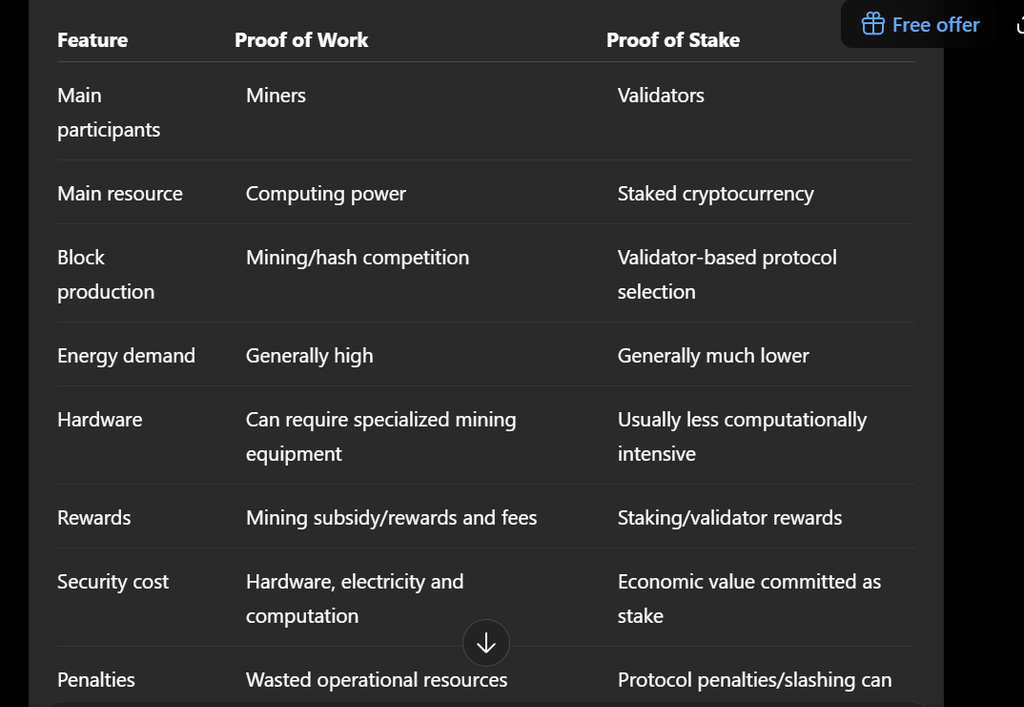
Although both mechanisms protect distributed ledgers, the resources they use are fundamentally different.
| Feature | Proof of Work | Proof of Stake |
| Main Participants | Miners | Validators |
| Main resource | Computing power | Stacked Cryptocurrency |
| Block Production | Mining/hash competition | Validator-based protocol |
| Energy Demand | Generally high | Generally much lower |
| Hardware | Can require specializing mining equipments | Usually less computationally intesive |
| Rewards | Mining subsidy/rewards and fees | Staking/ validators rewards |
| Security Cost | Hardware, electricity and computation | Econimic value committed as stake |
| Penalties | Wasted operational Resources | Protocol penaties/slashing can apply |
| Major example | Bitcoin | Ethereum |
Feature
Proof of Work
Proof of Stake
Main participants
Miners
Validators
Main resource
Computing power
Staked cryptocurrency
Block production
Mining/hash competition
Validator-based protocol selection
Energy demand
Generally high
Generally much lower
Hardware
May need special mining machinery
Less CPU intensive (typically)
Rewards
The incentive for mining subsidy/rewards and fees
Staking/validator rewards
Security cost
Hardware, electricity and computation.
The economic value of committing the stake.
Penalties
Wasted operational resources
There is the possibility of protocol penalties/slashing
Major example
Bitcoin
Ethereum
The first difference is straightforward: PoW involves consumers of the network doing work, whereas PoS involves investors staking their capital.
Energy Consumption: PoW vs PoS
One of the most obvious distinctions is in energy consumption.
While miners run a competition to generate blocks, PoW miners continuously do hashing operations. Mining large networks can thus be a requirement for a significant amount of electricity and specialized equipment.
Proof of Stake eliminates this sort of computational competition.
While validators require computers, internet connections and supporting infrastructure, they do not need to engage in the huge amounts of competition that are required for PoW mining.
The distinction is demonstrated in the case of the transition of the Ethereum network. The Ethereum Foundation estimated that The Merge saved the network an estimated 99.95% of its energy usage.
But, it is not necessarily the case that paying less energy means paying less transaction fees or higher throughput. The performance of the blockchain is influenced by various factors, including consensus, execution capacity, block design, network demand, and scaling technologies.
Is Proof of Work or Proof of Stake More Secure?
Proof of Work is a way to safeguard a network because it makes attacks costly and difficult. It takes tremendous amounts of hardware and electricity to take on large networks.
Proof of Stake, on the other hand, makes attacks costly by the ownership and control of staked cryptocurrency, and protocol penalties can be used to punish certain malicious actions.
Centralization issues are also an issue with both.
PoW mining may be focused by industrial miners and big mining pools.
Concentration risk can arise for PoS if a large number of stakeholders, such as large holders, staking pools, custodians, or service providers, have a large share of stake.
The security hence relies on the size of the network, the distribution of it’s participants, the design of the protocol, the economic incentives, software implementation, and the importance of securing the network.
Final Thoughts
The fundamental issue is how can a decentralized network reach a consensus on a valid blockchain history without relying on a single central authority, and Proof of Work and Proof of Stake are trying to tackle this very same problem.
They simply put different resources at risk.
Proof of Work makes it costly to manipulate by relying on miners, specialized computation, electricity and hardware.
Proof of Stake relies on validators and the use of cryptocurrency to incentivize correct actions, while also enabling protocols to punish some misbehaviors.
Bitcoin shows the PoW model and Ethereum is the most successful example of a PoW-based network that has since switched to PoS.