
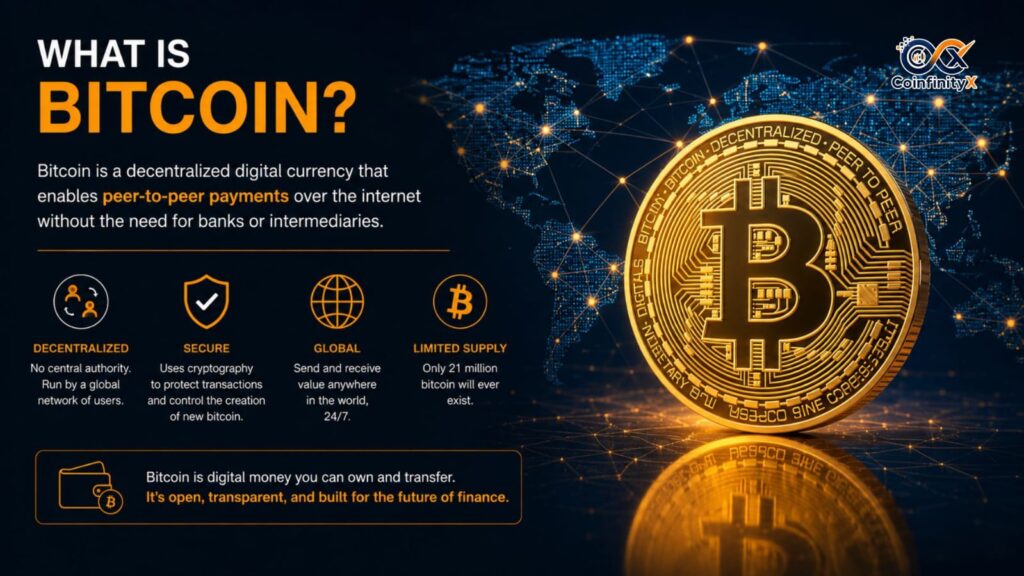
- Bitcoin is decentralized digital money. No bank, no government, just a global network of computers.
- Only 21 million will ever exist. Hardcoded scarcity makes it “digital gold” against inflation.
- You control it with private keys. Lose them, and your Bitcoin is gone forever.
What is Bitcoin? Bitcoin is a cryptocurrency that is not issued or regulated by governments or banks. Created in 2009 by the pseudonymous Satoshi Nakamoto, Bitcoin introduced a new form of digital money that is secured by cryptography instead of a central authority. It operates on a decentralized network of computers, allowing users to send and receive payments without relying on banks or other intermediaries.
Bitcoin is a decentralized currency, meaning it is not controlled by any government or financial institution like the U.S. dollar or euro. Instead, it runs on blockchain technology—a public, distributed ledger that records every transaction across a global network of computers. This transparent and secure system enables peer-to-peer transactions, making Bitcoin a borderless digital currency that anyone with an internet connection can use.
How Bitcoin Works
Bitcoin is based on three core principles: the blockchain, mining, and private keys.
The Blockchain
The blockchain is Bitcoin’s public ledger, a continually expanding string of ‘blocks’ that represent the data of transactions. Each block is securely connected to the previous one, which forms an unchangeable history of all the Bitcoin transactions that have ever occurred. This ledger is spread out among thousands of computers (called nodes) around the world, so no one can change or control the transaction history.
Whenever a person sends bitcoin, it is shared to the network, confirmed by nodes and put together to a block. After the transaction is recorded on the blockchain, it is no longer possible to change or delete the record, and it can be seen by anyone.
Mining and Proof of Work
The creation of new bitcoins and validation of transactions. The miners solve complex mathematical puzzles, which is known as Proof of Work (PoW), using customized computers. The first miner who solves the puzzle is awarded an additional block in the blockchain and is rewarded with new bitcoin.
Apart from adding new bitcoins to the supply (currently 3.125 BTC per block as of 2024), this process creates a secure network because it is difficult to hack or manipulate the blockchain. These puzzles get automatically harder every 2,016 blocks (roughly every two weeks) to keep the production rate of blocks at about 10 minutes.
The asset on their personal wallets is known as their private key.
Instead, bitcoin ownership is managed via private keys, which are cryptographic codes that are kept private and prove your permission to use the bitcoin that corresponds to your public address. What it is, really, is not much more complicated than a software program that controls these keys so you can send, receive and keep track of your Bitcoin balance. The private keys must be stored securely, otherwise there is a risk that the owner may lose access to their bitcoin and it may be permanently lost.
Bitcoin’s Limited Supply: The 21 Million Cap
The most unique aspect of Bitcoin is that there is a maximum of 21 million coins in circulation. The scarcity is built into the protocol and is enforced by the protocol consensus rules of the network. Unlike fiat currencies that can be printed as much as the central bank wants, the supply of Bitcoin is fixed, and it decreases over time.
The mining rewards are the method used to create new bitcoins, which are divided by half every 4 years or so, known as the “halving”. Starting at 50 BTC per block in 2009, the reward dropped to 25 BTC in 2012, 12.5 BTC in 2016, 6.25 BTC in 2020, and 3.125 BTC in 2024. This will be halved to 1.5625 BTC with the next halving in 2028. With a geometric reduction, more than 96.8% of all bitcoins will have been issued by 2028, with the last few coins being mined around 2140.
This capped supply is akin to rare metals such as gold which is why Bitcoin is called “digital gold.” Given that there’s a limited supply, and the demand is increasing, basic economics would dictate that the price of Bitcoin will appreciate over the long term – although in the short term it may fluctuate wildly.
Bitcoin is still considered a new currency today.Bitcoin remains a new currency today.
Bitcoin is fundamentally different from the fiat money in multiple ways:
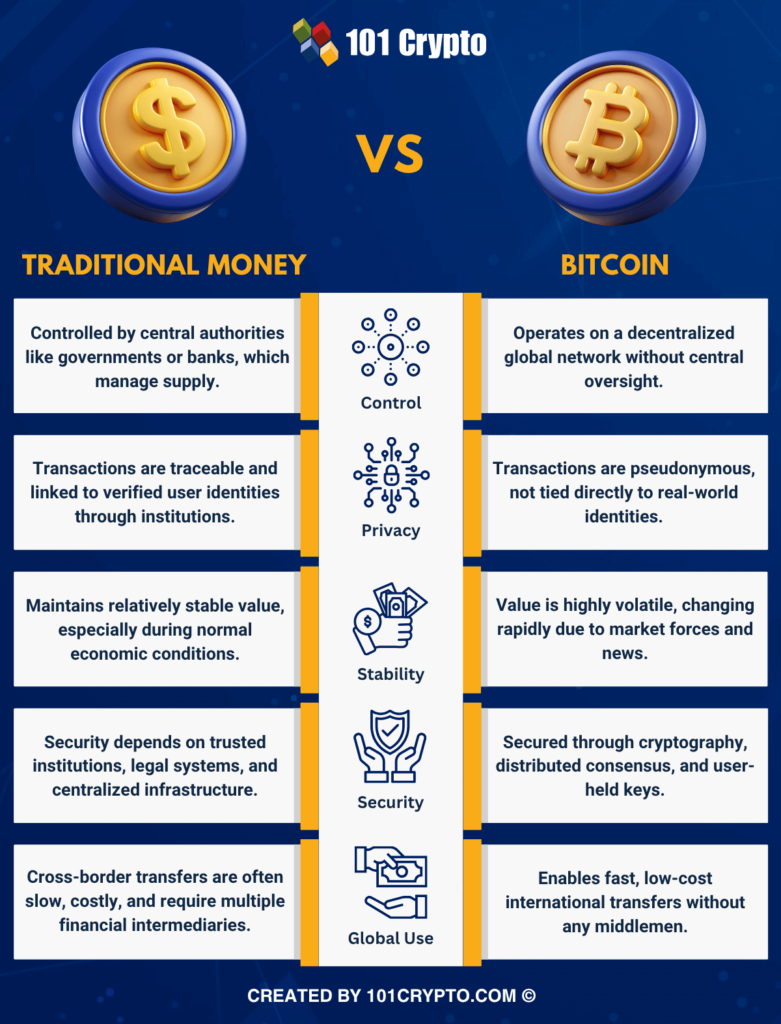
Everyone can access it, no restrictions on internet connection, but must have a bank account and ID to use it.
Bitcoin has proven to be a very attractive option in regions that have unstable currencies, capital control or limited banking services. But its volatility and regulatory uncertainty are big obstacles to making it a common payment method.
What is the reason behind the value of Bitcoin?
Bitcoin’s worth comes from numerous factors, such as its restricted offer (only 21 million Bitcoins will ever be mined), its utility (it can be used to transfer value across borders without the need for intermediaries), its security (cryptographic protection and distributed network), and its rising acceptance as a store of value and investment asset. Bitcoin’s price hit a new all-time high in October 2025, trading at around $126,210, marking its transition from an experimental technology to a recognized financial asset.
The new rate of institutional adoption has been rapid. Nowadays, major corporations, investment funds and even some governments are holding Bitcoin in their treasury reserves. El Salvador has implemented Bitcoin as legal tender in 2021, and some other countries have considered taking such a step. Bitcoin exchange-traded funds (ETFs) have begun trading in key markets, offering traditional investors a regulated way to gain exposure to Bitcoin.
The best place to buy Bitcoin is for beginners and buy with a regulated cryptocurrency exchange such as Coinbase, Kraken or Binance. These platforms do require identity verification (KYC) and have easy platforms for fiat buying of Bitcoins.
After buying your bits of Bitcoins, you’ll need to choose the proper way to store them:
Pros are compromised by the need to store their private keys with the exchange which can result in loss if the exchange fails. Well suited to low-volume and/or active trading.
Hot wallets: These type of software wallets are stored on your device, computer or mobile phone and allow you full control of your private keys. Safest than exchanges but they have internet connections.
Cold wallets are physical gadgets (such as Ledger or Trezor) or paper wallets that keep private keys out of the internet. For substantial property holdings, the safest way is to put it into a Trust.
Another fundamental principle of Bitcoin security: “He who controls the private keys controls the Bitcoin.” Don’t give a seed phrase out to anyone, don’t leave behind digital copies of seed phrases that can be hacked, and don’t write it down and give it out to anybody either.
Risks and Considerations
Bitcoin does have its risks. The volatility continues to be really high with loss leads of 50% or more not being unusual even in the best times of the bull market. Global regulatory environment remains opaque, and even some governments prohibit or limit the use of Bitcoin. Security concerns include hacks on exchanges, phishing, and that transactions are irreversible (confirmed transfers cannot be “undone”).
In addition, there are concerns about the energy use of Bitcoin. Proof of Work is a mining procedure that demands a lot of electrical energy, although renewable energy power sources can provide an increasing amount of such energy, and which necessitates some miners to join in a stabilization scheme for electrical grid.
Cryptocurrency investments involve substantial risk, and readers should conduct their own research (DYOR) before making any decisions. At CoinfinityX, our goal is to provide the educational foundation that makes that research easier—not to replace it.
The Future of Bitcoin
By 2026 Bitcoin has become much more than a thing for some niche enthusiasts. It now serves as a macro-economic asset, a stabilizer against currency debasement, and as a formative and growing technology to make an emerging financial system based on digital currency. Layer 2 protocols, such as the Lightning Network, tackle scalability issues, offering additional speed and cost-effective scaling options for regular use.
It is too early to tell if Bitcoin will be accepted as a global reserve currency, a digital gold standard or something completely none.It yet is too early to tell whether Bitcoin will grow to be accepted as a global reserve currency, a digital gold standard or something altogether none. One thing is not denying that it has forever changed the discussion on finance and its future, money and sovereignty.
Conclusion
Bitcoin is nothing if it isn’t a modern-day take on the concept of money. It did so by employing cryptography, a decentralized consensus mechanism, and economic incentives to make it the first scarce digital asset which is non-replicable, uncensurable and can’t be worthlessly inflated. To understand Bitcoin, one must grasp not only a technology, but a new system of attaching value to his transactions in a way that prevents any middlemen from interfering.
Like any investment, good research and a risk awareness are important. Bitcoin is still a volatile and experimental investment opportunity compared to conventional investments. However, Bitcoin presents an attractive opportunity – and one that is becoming more popular – for anyone willing to take the chance of a relatively new, but proven to be resilient, financial technology.
Whether you hold Bitcoin for the long term or seek yield through lending strategies, understanding the full ecosystem is essential. Read our guide to the Bitcoin Lending Renaissance to explore how BTC-backed loans work in 2026.
Frequently Asked Questions
Is investing in Bitcoin a safe bet?
Bitcoin is a highly volatile asset that carries significant investment risk. Although it has delivered strong long-term returns since 2009, it has also experienced multiple declines of 50%–80%. Invest only what you can afford to lose and treat Bitcoin as part of a diversified portfolio rather than your only investment.
What does the Bitcoin halving mean?
Bitcoin halving occurs roughly every four years and cuts the mining reward in half, reducing the rate of new Bitcoin creation. Historically, halvings have reduced supply growth and have often been followed by major bull markets.
Can Bitcoin be hacked?
The Bitcoin blockchain has never been successfully hacked. However, individual users can lose funds due to phishing attacks, exchange breaches, scams, or poor wallet security. Protecting your private keys is essential.
What is the Lightning Network?
The Lightning Network is a Layer 2 payment solution built on Bitcoin. It enables near-instant, low-cost transactions by processing payments off-chain before settling them on the Bitcoin blockchain.
Can Bitcoin replace the U.S. dollar?
Most experts believe Bitcoin is more likely to complement traditional currencies than replace them. It is widely viewed as a store of value, inflation hedge, and international payment network rather than a replacement for national currencies.
How much are Bitcoin transaction fees?
Bitcoin transaction fees depend on network activity. Fees are generally lower during quiet periods and can rise significantly during periods of heavy demand. The Lightning Network enables much cheaper transactions.
Can I buy a fraction of a Bitcoin?
Yes. Bitcoin is divisible into 100 million units called satoshis (sats). You can buy as little as a few dollars’ worth of Bitcoin depending on the exchange.
What happens when all Bitcoins are mined?
Around the year 2140, all 21 million Bitcoins are expected to be mined. After that, miners will earn revenue primarily from transaction fees instead of block rewards, helping secure the network over the long term.