
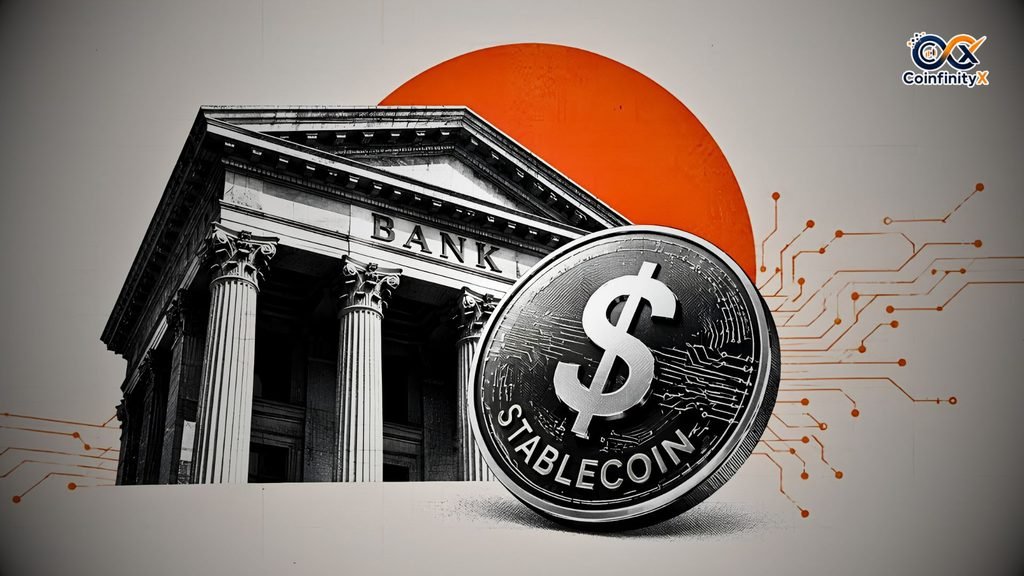
Banks are not suddenly interested in stablecoins because they have developed an appetite for crypto speculation. Their interest is much more practical.
While some of the fundamentals that underpin the traditional payment system are starting to be brought into question, the underlying premise of payment security is being fundamentally challenged.
Some of the core principles that underpin traditional payment infrastructure are being challenged, but payment security is being reimagined. Money does not always need to be held at bank hours, go through multiple intermediaries, or be outside the software used to conduct a financial transaction.
It can move around the clock, it can interact with smart contracts, and it can settle in parallel with tokenized assets. This presents a chance and a strategic challenge to banks.
In the event that stablecoins are a crucial layer in the transfer of digital currency, banks will have to make a choice: do they issue stablecoins, incorporate them into their current operations, offer infrastructure that supports them, or miss out on financial platforms that grab the payment volumes.
Stablecoins Are Becoming Financial Infrastructure
The significant shift is not just the expansion of the stablecoin market, but the evolution of the market itself. The big modification is not just the development of the stablecoin market, but the market itself. This is the way people are using stablecoins.
They are going beyond crypto trading to payments, remittances, treasury, merchant settlement, and on-chain financial markets. That is important because traditional money transfer is still very fragmented.
A business with overseas customers, suppliers, and staff may have customers in one market, suppliers in another, and staff in multiple markets. Funds transfers between them may be processed at different banks, in various currencies, payment systems, at various times, and through various reconciliation processes.
Stablecoins bring a new architecture. There may be a possibility that the value may move from one blockchain address to another at any point in time without all the transactions being linked with the correspondent banking relationships.
So, for the banks, the issue is not whether blockchain-based money exists anymore, it’s how much financial activity may be transferred onto these new rails.
The 24/7 Bank Is Becoming Possible
Traditional banking systems have been designed for window operations. Not the blockchain networks.
Stablecoins can trade round the clock and every day of the year, which can cause banks to reimagine their treasury management, international payouts, merchant settlement and more, processes typically limited to day-trade.
Suppose a company is operating in multiple markets and is concerned about liquidity risk. Without the need to wait for other payment systems to be available, blockchain-based money could enable the re-positioning of funds when they are needed.
That might render that as realistic just-in-time liquidity.
Although moving capital from one multiple account to another later might take too long, businesses may not have to hold a large supply of idle capital in various accounts.
Always-on money could therefore be an opportunity for banks to develop new products in the treasury arena, and not just a quick and dirty bank transfer.
Cross-Border Payments Are an Obvious Testing Ground
To illustrate the importance and attention being given to stablecoins, let’s have a look at international payments.
There can be several layers of cross-border reconciliation and correspondent banks. Each additional step will add cost, delay and complexity.
That chain can be potentially shortened with stablecoins.
A company may turn into a regulated stablecoin, move this to some other blockchain, and let the recipient hold this stablecoin or switch it for local currency.
It’s not always about getting rid of the banks in this process.
Banks have the opportunity to set up conversion points, handle liquidity, offer custody services, monitor transactions and link blockchain settlement to domestic payment mechanisms.
In that model, there is no removal of banks from the picture with stablecoins. They change what banks do.
Tokenization Makes Digital Money More Important
Tokenization is also inextricably linked to the stablecoin discussion. Financial institutions such as banks, asset management companies, exchanges, and market infrastructure providers are experimenting with blockchain-based bonds, funds, deposits, securities, and other financial instruments.
Solving only half of the problem by putting the asset on-chain. Also, there ought to be a cash flow available for the acquisition and settlement of that asset.
Let’s say two institutions wish to trade a security that is tokenized. Some of the tokenization’s
efficiencies are lost if the asset is on a blockchain, but payment is required to come out of the blockchain and into traditional infrastructure.
Among the assets that can serve as settlement are the stablecoins. They may also be used to facilitate the conditional transfer of the asset and the payment in the context of atomic settlement. Either both sides of the transaction settle or neither does. This will lower some types of settlement danger and link cash with programmable monetary assets.
Banks look at Programmability, Not Faster Payments
While a lot of focus is given to speed, programmability could be as crucial.
Traditional payments and software are usually disjointed. An application passes on a directive, banks execute the cash, and companies eventually reconcile the outcomes.
Smart contracts can directly communicate with blockchain-based money. That opens the door to payments based on a set of conditions, automated treasury operations, machine-to-machine payments, programmable refunds, etc., and collateral management.
Consider a financial arrangement with automatic liquidation of the collateral as soon as the payment is secured, or a business system with automatic liquidation based on agreed business rules.
The payment gets integrated into the software code. The payment becomes part of the software code. This could lead to a whole new class of financial services offerings that are centered on programmable money, instead of payment messages.
Stablecoins Also Create a Defensive Problem for Banks
Stablecoins aren’t just a liability for banks, there’s another reason. Another reason banks can’t afford to ignore stablecoins is deposits.
Deposits are one of the significant sources of bank funds. As more businesses and individuals start investing in stablecoins rather than bank accounts, some deposits may be removed from the established banking sector. This has raised questions of bank disintermediation.
But competition is not the only result that may be obtained.
Banks may play a significant role in the stablecoin economy. They can launch stablecoins, offer custody services, maintain reserves, offer fiat conversion, introduce blockchain payments or even create tokenized deposits.
The competition between the various formats of digital money, therefore, may be more a contest between stablecoins and banks, rather than a one-on-one affair.
Central Bank Money Is Unlikely to Disappear
Stablecoins need not supplant central bank money as the medium of exchange.
However, Central Bank money is one of the important risk-free settlement assets in the financial system. Commercial bank deposits will also continue to serve their purpose in lending, payments, and routine banking.
Stablecoins can serve various purposes. They are peer-to-peer, transferable and accessible on various blockchain platforms, which can make them especially valuable for situations in which the money is required to directly engage with digital assets and applications.
The new financial system might then feature multiple types of money in use: central bank money, commercial bank deposits, tokenized deposits and regulated stablecoins.
The challenge will be interoperability of those systems.
Regulation Could Turn Experimentation Into Banking Strategy
Banks are quite different from crypto startups. They are required to take into account the factors of liquidity, reserves, capital, consumer protection, sanctions, cybersecurity, anti-money-laundering requirements, and operational resilience when launching a new payment product. Therefore, regulatory clarity is paramount.
Stablecoin regulation is evolving in key financial jurisdictions, with various questions, including the quality of the reserves, redemption rights, governance, custody, and financial crime controls, being considered.
Clearer guidelines would help banks to leap from small trials to scaling up.
Regulatory considerations are also important, as stablecoins can go wrong.
The short-lived dollar peg that USDC had in 2023 following the failure of Silicon Valley Bank illustrated how issues in the broader financial system can impact even a dollar-backed currency.
The aim is not just about more stablecoins, then. It is about building resilience in structures when times are tough.
Conclusion
The heightened relationship between banks and stablecoins is fundamentally about infrastructure and not cryptocurrency.
Banks see the opportunity of settling assets faster across borders, 24/7 treasury operations, programmable payments, and digital money that can settle tokenized assets directly on-chain.
Simultaneously, there are critical considerations regarding deposits, liquidity, regulation, compliance, and financial stability with stablecoins.
That tension is what’s made the banks sit up and take notice.
Stablecoins will not be substitutes for commercial bank deposits or central bank money. On the contrary, they might become yet another component of a growing digital monetary system.