
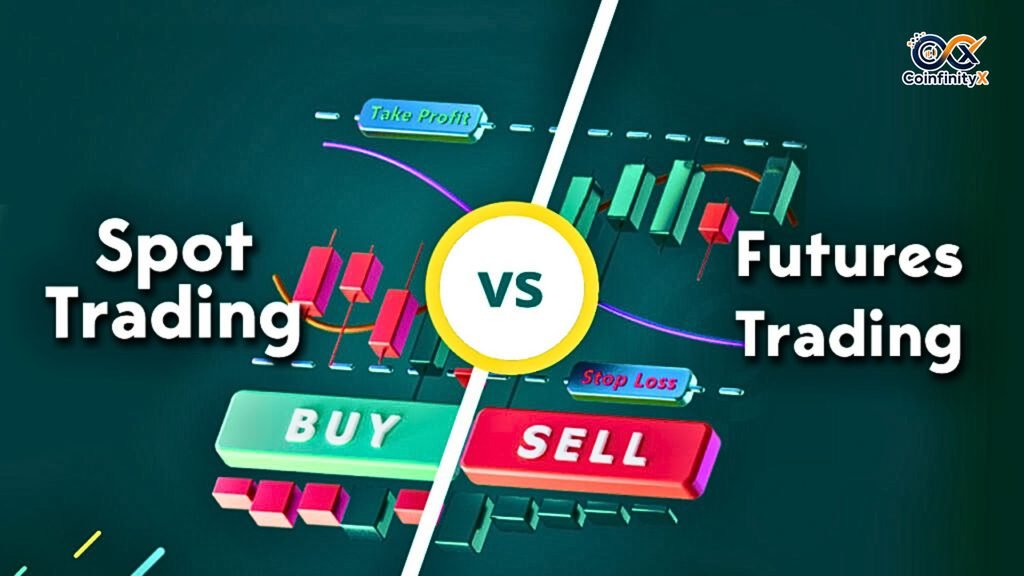
Traders can have exposure to crypto prices without being subjected to the spot market. Some traders acquire derivatives that enable them to speculate on the price of an asset without having to own the cryptocurrency.
Probably the most popular form of crypto derivatives is the perpetual contract, or perpetual futures contract, perpetual swap, or just “perp.”
Perpetual contracts are similar to futures contracts, but they do not have a fixed expiration date. As long as the traders meet the margin requirements and don’t get liquidated, they can leave a trade as long as they want. Perpetuals can also offer leverage, enabling traders to take trades that are more substantial than their collateral.
It’s a flexible approach, but with enormous risk. To grasp that, one has to have an understanding of perpetual contracts, leverage, margin, funding rates, and liquidation.
What Is a Perpetual Contract in Crypto?
A crypto perpetual contract is a derivatives contract that is based on the value of a cryptocurrency but has no fixed expiration date.
Let’s assume that a trader thinks that the price of Bitcoin is going to rise. The trader could alternatively have opened a long BTC perpetual position rather than purchasing the BTC outright.
If the trader believes that the price of Bitcoin will drop, they may go short.
The trader is thus betting on Bitcoin prices, not necessarily on the actual purchase and sale of Bitcoin.
There are two basic positions:
Long: The trader believes the price of the asset will go up.
Short: The trader believes that the price of the underlying asset will decrease.
Profit or loss is determined by the movements of the market from the position and trading fees, funding payments, and any other platform-specific costs.
How Do Crypto Perpetual Contracts Work?
The typical way a perpetual trade starts is when a trader selects a market, specifically a BTC or ETH perpetual contract.
The trader will then take a trade in the direction of their choice.
They then add margin as collateral for the position. In case of leverage, the trader can take a position larger than the position s/he is putting up as collateral.
A streamlined process is as follows:
Choose a market → Go long or short → Provide margin → Select leverage → Position opens → Market price changes → Close the position or face liquidation
Unlike conventional futures, there is no predetermined expiration date forcing the perpetual contract to settle.
However, keeping a position open may involve ongoing funding payments, and sufficient margin must be maintained.
Perpetual Contracts vs. Traditional Futures
The traditional futures markets and perpetual contracts are both derivatives, except for one thing, they are different because they have an expiration date.
Traditional futures contracts have a set time of settlement or expiration. Traders can expect to close or roll their trades near these dates. There are no expiration dates on perpetual contracts.
| Feature | Perpetual Contracts | Traditional Futures |
| Expiration date | none | Fixed |
| Long and short positions | yes | Yes |
| leverage | Often available | Often available |
| Underlying ownership | Usually no | Usually No |
| Price alignment | Often uses funding | Convergence towards Expiry |
Perpetual contracts do not have an expiration date and must otherwise have another way to incentivize the market price to stay close to the price of the underlying cryptocurrencies. This is where Funding Rates come into play.
What is Leverage in Perpetual Trading?
One of the key, and risky, characteristics of perpetual contracts is leverage. The trader can control a position greater than the sum of the money deposited.
Assume a trader has $1,000 to trade with and that he has 5 times leverage.
The exposure in the market would be:
$1,000 margin × 5 = $5,000 position
After factoring in fees, funding, and other adjustments, the trader’s $5,000 position trades by approximately $200 for every 4% move in the underlying cryptocurrency.
That would be a 20% increase over the original $1,000 margin. Leverage is a two way street.
Instead, a 4% move against the position would result in an approximate $200 loss.
The higher the leverage, the more a slight unfavorable price change could lead to the liquidation of the position.
Spot Trading vs Perpetual Contracts
The main difference between trading perpetuals and spot trading is particularly significant for traders who are new to the market.
| Feature | Spot Trading | Perpetual Trading |
| Own underlying crypto | Usually yes | Usually no |
| Long exposure | Yes | Yes |
| Short exposure | Less straightforward | Common |
| Leverage | Often none | Common |
| Funding payments | No | Usually |
| Liquidation risk | Not for ordinary unleveraged holdings | Yes |
| Expiration | Not applicable | None |
Why Do Traders Use Perpetual Contracts?
- There is speculation as one reason. Perpetuals enable traders to engage in trades based on their speculation of the asset’s price trend.
- Another is hedging. For instance, a Bitcoin long might want to hedge a portion of their short exposure to BTC by buying a short BTC perpetual.
- Another way to gain capital efficiency from perpetuals is by using leverage, which allows traders to achieve greater market exposure while putting up less money initially.
- Lastly, without an expiration date, traders don’t need to roll a contract just because of the arrival of a settlement date.
What Are the Risks of Perpetual Contracts?
The most apparent risk is leverage. Relative to the trader’s margin, relatively small price changes can lead to big losses due to leverage.
Other significant risks are:
- Risk of liquidation: If the leveraged position is losing money, the position can be liquidated automatically.
- Risk of funding: It can be costly to retain a position if funding is made regularly.
- Market volatility: Cryptocurrencies can experience rapid price fluctuations in a short time.
- Liquidity Risk: During periods of volatility and/or low liquidity, trades may be executed at less-than-optimal prices.
- Platform risk: Centralized exchanges introduce risks of holding custody of the assets and counterparty.
- The risk of smart contracts: Decentralized perpetual platforms could rely on unsafe code.
- External pricing mechanism risk (Oracle or index): Pricing mechanisms are external to some systems.
These risks render perpetual trading much more complicated than just holding cryptocurrency.
Are Crypto Perpetual Contracts Suitable for Beginners?
Perpetual contracts can appear easy on the surface because it can simply be a couple of clicks to open a long or short position. Getting a comprehension of the danger in that position is trickier.
To master how a perpetual position works, a trader should be familiar with concepts such as leverage, margin, funding, liquidation, mark prices, fees and volatility.
If you’re interested in learning how these mechanics work but don’t want to risk your actual money, you can try a demo or paper trading account.
Last but not least, knowing how a perpetual contract works doesn’t necessarily make a trader certain about the price of cryptocurrencies.
Final Thoughts
Derivatives are instruments that enable traders to speculate on cryptocurrency prices, with no predetermined expiration date, the crypto perpetual contract is a type of such derivatives.
Traders can buy when they think prices will go up, and sell when they think prices will go down. They can also leverage to get larger exposure in the market.
That leverage is one of the hallmarks of perpetual trading, though: losses can be amplified as well as profits, and significant losses can result in liquidation.
Another key element to the system is funding rates, which help facilitate perpetual prices matching their underlying spot markets.