

- Trump’s quantum push has revived concerns about Bitcoin’s cryptographic security.
- Future quantum computing could threaten up to $449 billion in Bitcoin holdings.
- No short-term threat exists. Quantum-resistant solutions are already in development.
The rapid advancement of quantum computing has once again sparked debate across the cryptocurrency industry. Trump’s Quantum Push has intensified concerns about Bitcoin’s long-term security after US President Donald Trump introduced new initiatives aimed at accelerating America’s quantum computing capabilities. While quantum technology is still in its early stages, experts warn that future breakthroughs could potentially challenge the cryptographic foundations that secure digital assets such as Bitcoin.
Recent discussions surrounding Trump’s Quantum Push have focused on an estimated $449 billion worth of Bitcoin that could become vulnerable if powerful quantum computers eventually gain the ability to break current encryption standards. Although this scenario remains years away, the latest developments have brought the issue back into focus for investors, developers, and cybersecurity experts.
Why Trump’s Quantum Push Matters for Bitcoin
Bitcoin’s security relies on advanced cryptographic algorithms that protect wallet ownership and validate transactions across the blockchain network. Traditional computers would require an impractical amount of time to crack these encryption methods, making Bitcoin one of the most secure digital systems in existence today.
Quantum computers, however, operate differently. By utilizing the principles of quantum mechanics, these machines can process complex calculations far more efficiently than conventional computers. In theory, sufficiently advanced quantum systems could eventually solve mathematical problems that underpin modern encryption technologies.
This possibility has raised concerns about whether Bitcoin’s current security model could remain effective in a future dominated by quantum computing.
Trump’s Quantum Computing Push
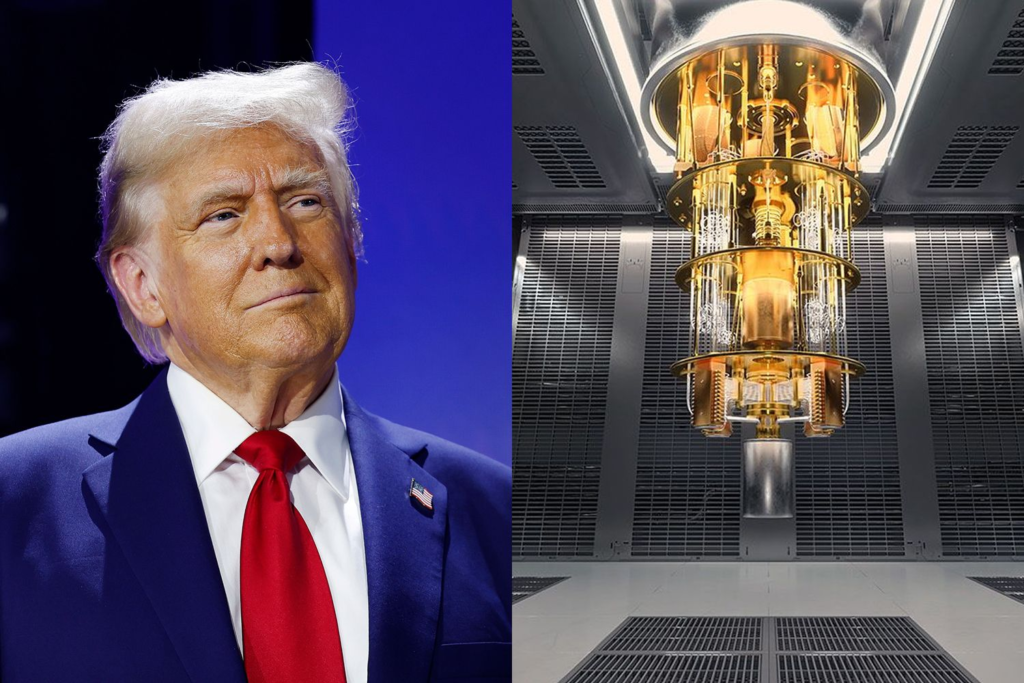
The renewed attention on Bitcoin security follows the Trump administration’s efforts to strengthen the United States’ position in the global quantum computing race. The initiative aims to accelerate research, encourage innovation, and improve the country’s technological competitiveness against rivals investing heavily in next-generation computing technologies.
While the administration’s strategy is primarily focused on scientific advancement and national security, the announcement has also triggered discussions within the cryptocurrency sector. Any major breakthrough in quantum computing could have implications for financial systems, cybersecurity infrastructure, and blockchain networks worldwide.
As governments and technology firms increase investments in quantum research, market participants are paying closer attention to the potential long-term effects on digital assets.
Understanding the $449 Billion Exposure
The widely discussed figure of $449 billion refers to Bitcoin holdings associated with addresses whose public keys have already been exposed on the blockchain. Security researchers argue that these addresses could theoretically become more vulnerable if quantum computers become powerful enough to exploit weaknesses in current cryptographic systems.
However, it is important to understand that this is not an immediate threat. Today’s quantum computers remain far from possessing the capabilities required to compromise Bitcoin’s security. Most existing machines are limited in scale and face significant technical challenges related to stability and error correction.
Nevertheless, the sheer size of the potentially exposed Bitcoin holdings highlights why the crypto industry continues to monitor developments in quantum computing closely.
Industry Preparing for a Post-Quantum Future

The good news for Bitcoin users is that developers are already exploring solutions designed to withstand future quantum threats. Researchers are actively working on post-quantum cryptography, a new generation of encryption methods specifically created to resist attacks from quantum computers.
Several blockchain projects have begun investigating quantum-resistant digital signatures and other security upgrades that could be implemented if the technology becomes necessary. These efforts demonstrate the industry’s proactive approach toward maintaining network security over the long term.
Many experts believe Bitcoin could adopt new cryptographic standards before quantum computers become powerful enough to pose a genuine risk.
What Investors Should Know
For investors, the latest headlines should be viewed as part of a broader discussion about the future of technology rather than an immediate market threat. Bitcoin continues to face more pressing influences, including regulatory developments, institutional adoption, monetary policy decisions, and overall market sentiment.
While quantum computing remains an important topic, most analysts agree that practical risks are still years away. The cryptocurrency ecosystem has ample time to develop and implement protective measures as the technology evolves.
Conclusion
Trump’s push to accelerate US quantum computing research has reignited conversations about Bitcoin’s long-term security and the future of blockchain technology. Although concerns surrounding the estimated $449 billion in potentially exposed Bitcoin have captured attention, experts emphasize that quantum computers are not yet capable of breaking Bitcoin’s encryption.
As innovation continues on both sides of the equation, the race between quantum computing advancement and quantum-resistant cryptography is likely to shape the next chapter of digital asset security. For now, Bitcoin remains secure, but the industry is already preparing for a future where quantum technology could become a significant factor.