

A stablecoin may look like just another token moving across a blockchain, but its most important feature is something users cannot see directly: the mechanism that keeps its price close to a target.
For a dollar-pegged stablecoin, that target is usually $1. The challenge is that markets do not automatically respect a target price. Buyers and sellers determine the market price, and that price can move whenever demand, liquidity, or confidence changes.
Then why does a stablecoin float around $1 and not act like the other digital assets do?
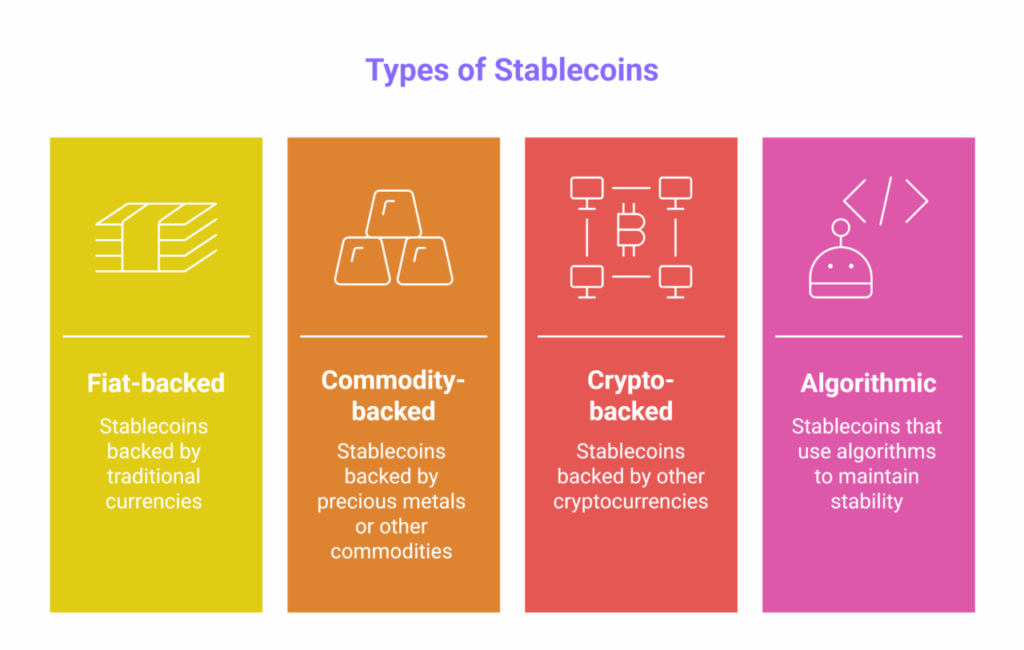
The answer will be dependent on the object behind the token. Other stablecoins are backed by assets off-chain. Some people rely on crypto collateral and auto liquidation. Some rely on algorithms and economic incentives. In all of these models, redemption, arbitrage, liquidity and confidence are all significant factors.
This isn’t just a promise, it’s a stablecoin’s peg. It is an economic system that is intended to maintain a connection between a digital asset and an outside reference.
A Stablecoin’s Value Starts With Its Connection to Something Else
The value of a stablecoin is pegged to a reference value, which, unlike Bitcoin or other assets whose markets are driven largely by supply and demand and by expectations, is more stable.
A dollar-pegged stablecoin is a stablecoin that is designed to maintain a stable value, with each token held equivalent to the value of one U.S. dollar.
That reference provides a predictable unit of account for the token. It is especially helpful in the decentralized finance sector, where traders, lenders, borrowers, and liquidity providers require an asset with a lower volatility than the majority of cryptocurrencies.
Stablecoins can thus serve as a link between volatile digital currencies and financial transactions necessitating a relatively stable price.
But the stability of the reference is not guaranteed.
A meaningful link between the token and the asset that it represents is required. It could be a connection from reserves, collateral, redemption rights, smart contracts, or economic incentives.
The more that connection is strong, the more confident the users can be that it can preserve the desired value of the token.
The Peg Is Defended by Economic Incentives
Stablecoins are best understood as a target that the market is continuously aiming for.
Assume a stablecoin whose value is backed by dollars drops to $0.98.
If the token can be bought on the market at $0.98 and it is worth about $1, it is possible to make money. The token is sold at a discount and it can be redeemed to profit from the difference between the sale and redemption price, minus fees and other expenses.
That activity generates buying pressure when the stablecoin is trading below its target.
Conversely, if the token’s price goes up above $1, the opposite can occur. When market participants can mint or buy new tokens for around $1, and sell them for higher in the open market, the price can keep dropping.
One of the fundamental principles behind one of the most crucial factors for stablecoin pegs is arbitrage.
Arbitrageurs are not doing it for the sake of the stablecoin, but more because of their loyalty to the protocol. They are reacting to the price disparity.
If they are after potential profits, they can help to return the price towards the target.
Fiat-Backed Stablecoins Put Reserves at the Center
The most familiar stablecoin model connects tokens to traditional financial assets.
Under this structure, an issuer holds reserves intended to support the stablecoins in circulation. Those reserves may include cash, bank deposits, short-term government securities, or other assets depending on the specific arrangement.
The critical relationship is between the number of tokens in circulation and the assets backing these tokens.
This makes the token more closely tied to its target price when the users think that they can redeem their stablecoins for the underlying value.
This is why there is need for transparency in reserves.
Investors and market participants want to know what the tokens are backed by, where the assets are being stored, how liquid they are, and if the issuer is able to redeem the tokens upon demand.
There is no correlation between a reserve and a stablecoin. The quality and availability of those reserves is also important, as is their management.
Crypto-Backed Stablecoins Replace Traditional Reserves With Collateral
The way that crypto-backed stablecoins solve the problem is different.
They do not require the traditional financial assets of an issuer as their main source of collateral, but rather rely on the use of cryptocurrency as a collateral.
It’s no secret that the trouble lies in the volatility of the cryptocurrency market.
These systems typically employ overcollateralization to offset that volatility. A user might need to stake a lot more cryptocurrency than the amount of stablecoins they receive.
For example, a protocol could require $150 worth of crypto collateral to issue $100 worth of stablecoins.
The system has some protection against the loss of value of the collateral, before the position becomes undercollateralized. Smart contracts can keep track of the position and initiate liquidation when certain threshold limits are met. This provides an essentially new system of financial management.
The rules can be built into software, rather than relying on a centralized institution to keep track of borrowers and ensure the collateral is in place.
The downside is that the system is heavily reliant on the design of the smart contracts, the liquidity in the collateral, price information and the liquidation processes themselves.
Algorithmic Models rely more on Market Incentives.
A few stablecoin models attempt to peg the currency without the use of traditional reserves as a primary means of doing so.
Rather, they manipulate the supply and demand through algorithms and economic incentives.
The system will adjust supply based on the price of the token, if it exceeds the targeted price.
When it drops below the target, mechanisms can lean on the market to remove tokens from circulation and/or encourage market participants to purchase or reduce the supply of the tokens.
The idea is simple – adapt to market conditions by modifying the economic incentives of the token.
Liquidity Is the Missing Piece in Many Peg Discussions
Even if a stablecoin has reserves it can still be under stress.
Why?
But a reserve is not a liquidity to market.
While a stablecoin can be backed by assets, it still requires active markets for users to trade, redeem, or purchase the stablecoin.
In normal conditions, with small price differences, traders can shift capital among exchanges and protocols on time, and price differences are able to be easily adjusted.
Liquidity may get thinner during periods of stress, however. Trading costs can increase, redemption channels may become restricted, and arbitrage may become more difficult.
This means liquidity is a crucial component of the peg.
However, the stability of a token also relies on how easily users can transfer and navigate from the token to the market and to the value of the token.
Final Thoughts
A stablecoin’s value is not created simply by declaring that one token equals one dollar. Its value comes from the mechanism connecting the token to that target.
Stablecoins that are backed by Fiat money are highly reliant on reserves and redemption. Crypto-backed models are based on collateral and automated liquidation. Algorithmic designs are more based on supply adjustments and market incentives.
In all these structures, arbitrage and liquidity contribute to making those mechanisms into a market price. This is why it’s important to delve into the details of understanding a stablecoin beyond its name or its stated peg.
More critical questions will be what holds up the token, how easy or difficult it will be for users to redeem it, how the markets will react to the changes in the price of the token, and whether the system can remain effective when there are a few tests of confidence.
That’s a key difference for payments, tokenized financial markets and DeFi.
A stablecoin is no good without a credible mechanism to ensure its stability.