
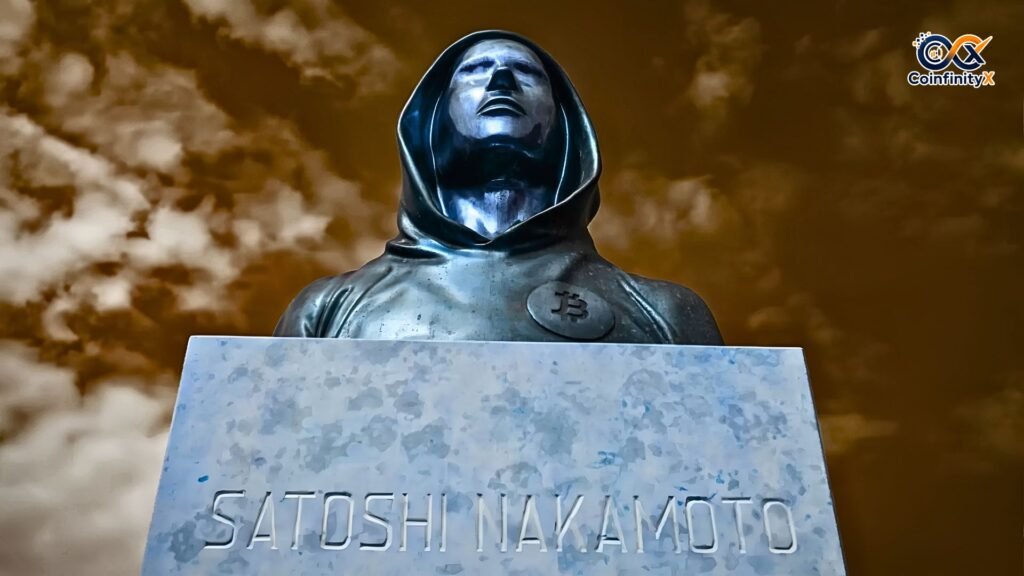
Bitcoin began with a whitepaper, a new idea for digital money, and a name that has never been connected to a confirmed identity. Satoshi Nakamoto is the pseudonym used by the person or group credited with creating Bitcoin and publishing its original whitepaper in 2008.
Over the past 15 years, no one has been able to provide true proof of who Satoshi truly is. There have been numerous suggestions in the naming of Bitcoin, and several people have made claims to be the creator of Bitcoin. No one has been identified as a definite Satoshi.
What is obvious is the system that Satoshi has created. Bitcoin was created to enable people to move value straight over the internet without relying on banks or another central middleman. This decentralisation and the concept of self-sovereignty are an integral part of Bitcoin’s identity right up to the present day.
Who Is Satoshi Nakamoto?
Bitcoin, a Peer-to-Peer Electronic Cash System was published in October 2008 by Satoshi Nakamoto. The paper outlined a digital payment system that would enable individuals to transfer money to each other, without necessarily engaging any financial institution to facilitate each transaction.
It was a critical moment. There was a significant financial crisis in the world and confidence in financial institutions was shaken.
In January 2009, the first release of the Bitcoin software was available. The first block, called the Genesis Block, which started the Bitcoin blockchain was mined by Satoshi.
Satoshi corresponded with early developers via email, internet forums and discussions. Most of these discussions were about the code, security, network design and technical issues of Bitcoin.
At the end of 2011, Satoshi’s communication ceased to be effective. The developer had left the project, making it a project for a growing community of developers and users.
It is not clear if Satoshi was an individual or a group.
The Problem Satoshi Wanted to Solve
The double-spending issue was one of the greatest challenges to digital money before Bitcoin. Digital information can be copied. If it is not possible to track who owns the digital money, people could be able to send it to various people.
In traditional financial systems, the solution to this is to use an intermediary. Payment processors and banks keep track of and check payments. This establishes a secure and central location to manage balances and to avoid the double spending of the same funds.
Satoshi had an alternative solution. In Bitcoin, transactions are broadcast to the participants of the network and are recorded on the shared blockchain, which is a peer-to-peer network. This is because the network maintains the ledger, rather than a single institution, through cryptography, a consensus mechanism known as Proof of Work, and incentives.
The miners compete with each other to add new blocks to the blockchain by using computing power. Every block is connected to the next one, and they form a history of transactions.
If an old transaction were to be modified, it would need a lot of work to do this. This design enabled the sharing of a common record without the need for a central authority.
The Genesis Block
Bitcoin officially launched on January 3, 2009, when Satoshi was mining the Genesis Block.
One of the blocks features a well-known reference to a second bailout of banks in the Times newspaper. The message is frequently mentioned as it gives a date when the first block was created and shows the financial landscape at the time of Bitcoin’s inception.
The Bitcoin blockchain has been growing from that first block. The concept was to have a distributed system act as the network’s security mechanism, rather than relying on a single central authority to perform this function.
Who Could Satoshi Nakamoto Be?
One of the greatest mysteries of cryptocurrency has always been who Satoshi is.
Writing styles, e-mailing, forum posts, programming approaches, technical backgrounds, and links to the early cypherpunk community were studied. These investigations have been unsuccessful, however, and as of yet no candidate has come up with the kind of cryptographic proof that would definitively establish their identity.
Hal Finney
Hal Finney was a cryptographer and Bitcoin’s early adopter. He downloaded the software as soon as it was released, and assisted in the testing of the network.
The first Bitcoin transaction that Finney received was from Satoshi, who sent him 10 BTC.
He helped create its technology and has a wealth of expertise, so it has been suggested that he might be Satoshi. Finney, however, refused to accept that he was the creator of Bitcoin.
Nick Szabo
Another common name that is thrown out in the ring is Nick Szabo. Prior to the invention of Bitcoin, Szabo developed a concept for digital money, called Bit Gold, that incorporated ideas on cryptography and decentralized verification.
There have been speculations that Bit Gold is a connection to Bitcoin, due to its similarities. But Szabo has dismissed his assertion that he is Satoshi.
Len Sassaman
Len Sassaman was a cryptographer and member of the cypherpunk movement and privacy tech.
When discussions and documentaries surfaced around candidates for Satoshi, his popularity increased. But he has yet to be proven to be the creator of Bitcoin.
Craig Wright
In 2016, Craig Wright is making the claim to be Satoshi Nakamoto, officially.In 2016, Craig Wright officially claims to be Satoshi Nakamoto. His assertion sparked lots of controversy and legal action.
The High Court of England and Wales in 2024 determined that Wright is NOT Satoshi Nakamoto and NOT the author of the Bitcoin whitepaper nor the creator of the Bitcoin system.
How Much Bitcoin Did Satoshi Mine?
Another major mystery concerns how much Bitcoin Satoshi may have mined during the network’s earliest days.
Blockchain researchers have analyzed patterns in early mining activity. One widely discussed analysis identified what became known as the Patoshi pattern, a pattern associated with a large amount of early Bitcoin mining.
Some researchers have estimated that Satoshi may have mined around one million Bitcoin, although estimates vary and the exact amount cannot be confirmed. These coins are especially interesting because many of the addresses associated with early mining have remained inactive.
If coins believed to belong to Satoshi were ever moved, the transactions would be visible on Bitcoin’s public blockchain. However, the movement of coins alone would not necessarily prove who controls them.
The reason many early coins remain untouched is also unknown. The private keys could have been deliberately left unused, lost, or simply held without any intention of spending the funds.
Why Did Satoshi Disappear?
As other developers stepped in to actively participate, Satoshi gradually decreased his involvement with Bitcoin. From 2010 and 2011, the software was more and more maintained and developed together with other contributors. Among the developers that rose to prominence in the early days of Bitcoin was Gavin Andresen.
Satoshi ended up with his last messages indicating that he had gone on to other things. Since then, there has been no known message from Satoshi. There are a number of theories regarding the anonymity and disappearance of Satoshi. Privacy may have been one reason. It might have been another decentralized philosophy of Bitcoin.
This anonymity also helped to keep Bitcoin from being strongly linked to one of the public founders. Instead, development went via an open-source community.
Satoshi’s Legacy: Self-Sovereignty and Decentralization
Perhaps the most significant thing about Satoshi is that he didn’t reveal himself, but the ideas he built into Bitcoin’s design. Bitcoin enables people to store and trade virtual properties without the need to have a bank run the underlying network. Users who have their own private keys will have the ability to manage their own bitcoins without relying solely on a third party.
Self-custody or financial self-sovereignty is oftentimes how this comes across.
The saying goes: “Not your keys, not your coins.” It reminds people that private keys are an integral part of who is in control of Bitcoin.
Self-custody is accompanied by responsibility, however. The loss of private keys or recovery information may result in the loss of funds. Users have to be aware of security issues while handling their assets.
The anonymity of Satoshi also aligns with the decentralized nature of Bitcoin. Bitcoin has relied more on developers, miners, node operators, businesses, and users without any known founder to guide the development process.
Closing Thoughts
It’s been 15 years and more since the enigmatic Satoshi Nakamoto has shrouded the cryptocurrency sector with mystery.
Numerous individuals have been recommended as the originator of Bitcoin. Some people have gone so far as to proclaim themselves as it. But no one has offered a valid crypto-proof of authorship of Satoshi Nakamoto.
Bitcoin introduced an innovative mechanism to move digital value via a decentralized network and without relying on a central financial intermediary. It introduced a new paradigm for digital assets with its blockchain, Proof of Work consensus approach, and private-key ownership.