
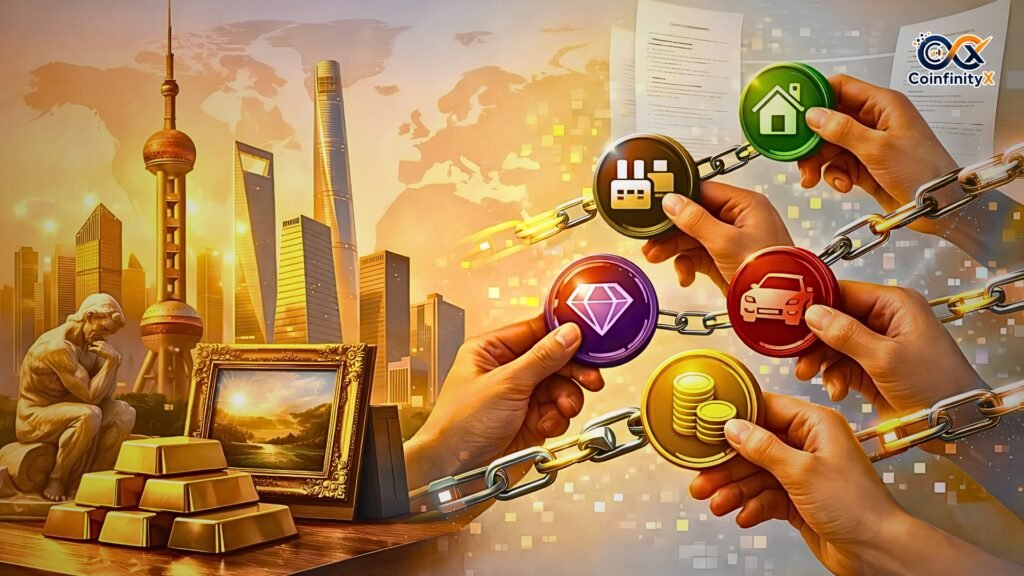
Blockchain technology is transforming more than the use of cryptocurrency. It’s also transforming the way traditional assets can be owned, transferred and managed. One of the biggest developments in this area is real-world asset tokenization.
In the real world, asset tokenization means that tokens are created, which represent the ownership or rights of an asset, other than the blockchain. They can consist of real estate, government bonds, gold, stocks, commodities, artwork, and private credit.
Ownership data can be recorded on a blockchain, rather than in a conventional document. This can help smooth certain financial processes and make them more open and accessible.
It’s becoming very well known within the financial sector, blockchain firms and investors. However, tokenization is still in its infancy and is faced with challenges in the technical, legal and financial aspects.
What Is Real-World Asset Tokenization?
Real world asset tokenization means making blockchain-based tokens as a representation of an asset or a legal claim to an asset.
Think of a building worth $1 million. Under a traditional system, ownership may be recorded through legal documents and government registries.
Under tokenization, a digital token may be a stake of ownership or an economic claim in relation to that asset.
The token is stored on a blockchain. The value and rights are based on the legal structure of the project.
This last point is important. A token does not automatically give someone legal ownership of an asset simply because it exists on a blockchain. Issuers will need to develop a framework to link the digital token to the actual asset. These can be contracts, custodians, companies or trusts.
How Does Asset Tokenization Work?
Typically, there are several steps in the process.
Firstly, an asset is chosen to be tokenized. It may be a property, bond, gold, private loan or anything else.
The issuer then sets up the legal framework. This step defines the token’s meaning and the privileges that the token owners will have.
This asset is then linked to a token based on blockchain. Smart contracts can be used to create and manage these tokens.
The tokens can be transferred among eligible users, for instance, if issued to a single user.
Suppose a house is broken up into 10,000 virtual tokens. The token may symbolise a share in the economic interest in that property.
It’s not that an investor necessarily has a stake in the actual building. Rather, it might represent a fixed financial interest under the legal provisions of the project.
This can help to make difficult-to-represent assets easier to represent in a digital form.
What Assets Can Be Tokenized?
Any asset with a known owner or economic rights might easily be tokenized.
One of the most talked about is real estate. With tokenization, investors can make investments in a property without buying the entire building.
Another key category is government securities. Government bonds can be traded as tokens on government blockchain networks.
Commodities may additionally be tokenized. For instance, gold-backed tokens can be used to represent a claim to real gold that is kept by a custodian.
Other options are private credit, company shares, investment funds, artwork, carbon credits, and intellectual property.
The use case will vary depending on whether the asset can legally and practically be linked to a digital representation.
Why Does Tokenization Matter?
There are several processes in the traditional financial system which can be slow and costly.
A number of intermediaries may be required to buy property, transfer securities, complete trades, and record and manage ownership.
Some of these processes may be simplified with tokenization.
Blockchain networks can make a real-time record of transactions. Additionally, smart contracts can enable automatic procedures to occur if certain conditions are fulfilled in advance.
This will help to lessen the manual workload for some financial transactions.
But, blockchain is not the magic bullet that gets rid of all intermediaries. Legislation, custodians, brokers, banks and other service providers might still be needed.
The key difference here is that some aspects of the process can be shifted to a programmable digital infrastructure.
Improving Access to Investments
Tokenization could also make some assets easier to access.
Traditional assets often require large amounts of capital. Buying an entire commercial property, for example, may be out of reach for many investors.
An asset can be broken down into smaller units with tokenization. This can be referred to as fractionalization. There may be several investors with smaller holdings in an asset rather than one investor buying the entire asset.
For example, a $10 million property could theoretically be represented by one million tokens. An investor could purchase a smaller number of tokens rather than buying the whole property.
But fractional ownership isn’t about itself indicating that an asset will be accessible to all. Restrictions may apply to buying some Tokenized Assets. There may also be minimum investment amounts that apply.
Greater Transparency
Another possible benefit is blockchain technology.
The users of a public blockchain can see and validate transactions (depending on the network and project architecture). This can make tracking the movement (and ownership) of the tokens easier.
Transparency can be helpful for investors if they are considering the distribution and transfer of tokens. But, blockchain transparency has its boundaries.
The blockchain will be able to trace the history of a token. It does not necessarily imply a real underlying asset or that the issuer has the legal rights to the underlying asset.
In tokenized asset markets, audits, legal agreements, custodians, and trusted third parties can continue to play a crucial role.
Faster Settlement
Regular transactions in the financial centres may be slow to clear.
There are a number of institutions which may have to communicate prior to a formal transfer of ownership.
Potentially, tokenized assets can settle directly on the blockchain networks. Parts of the process can be automated using smart contracts.
This may expedite the settlement process and mitigate some administrative expenses.
A quick settlement for global markets might be more beneficial. In contrast, a blockchain network functions around the clock, whereas conventional markets might be closed on weekends or holidays.
However, in the real world, legal and financial infrastructures can operate off the blockchain.
New Opportunities for Financial Institutions
Banks and asset managers are also exploring tokenization. Blockchain might offer financial institutions a new infrastructure for the issuance, transfer and management of assets.
Rather than developing totally new systems for various products, institutions may leverage blockchain networks to power specific elements of their work. One such example is tokenized funds.
Digital tokens could be issued by an investment fund to represent shares of the investment fund. Smart contracts could then facilitate transfers and other administrative functions.
This could eventually lead to the development of more integrated financial markets, where traditional finance and digital finance are more readily connected.
The Role of Smart Contracts
One of the key elements of asset tokenization is smart contracts.
A smart contract is a program that is self-executing and follows the rules that are programmed into the contract.
Smart contracts can be utilized to manage trades, payments, distributions, and other tasks for tokenized assets. In a tokenized bond, for instance, the smart contract infrastructure could be used to allocate interest payments to the eligible holders.This helps to minimize the manual handling of each transaction.
Smart contracts, however, are computer programs. Losses can be caused by bugs or security issues. They need to therefore be well designed and well audited.
What Are the Risks?
There are a few risks associated with tokenization.
- The first is regulatory uncertainty. Securities, property and investment products, and digital assets are governed by different regulations in various countries.
- A token can also be handled differently based on the rights that it gives.
- The other risk is the association of the token and the physical asset. When every token is backed by a physical gold, investors do need a way to validate that the gold is there and correctly stored.
- Another issue is custody. There has to be someone who is able to hold the asset in question in safe hands.
- Blockchain risks exist, as well. Tokenized assets may be impacted by network failures, smart contract bugs, hacking, and wallet security issues.
- liquidity may be an issue.
Real-World Asset Tokenization vs. Cryptocurrency
While blockchain is a technology used in both tokenized assets and cryptocurrencies, the two are not identical.
One example is Bitcoin, which is an inbuilt digital asset. It is not an actual material like a building or a government bond.
A tokenized real-world asset is an asset that is linked to the real world economy.
This establishes the connection between blockchain networks and the present monetary markets.
The two categories can also complement each other. Investors may be able to buy tokenised assets with their blockchain money, and hold their investments within digital wallets.
The Future of Tokenized Assets
Real-world asset tokenization is still developing.
It’s an industry that will require regulation, technology, investor demand, custody capabilities, and blockchain network interoperability with traditional finance systems to thrive over the long haul.
With these obstacles overcome, tokenization may impact the issuance and transfer of numerous assets.
Blockchain could be used for settlement and recordkeeping within financial institutions. Smaller amounts of some assets may be available to investors. Smart contracts may replace the manual handling of financial administration.
However, tokenization isn’t a panacea for all challenges in traditional finance.
The technology can help the representation and transfer of assets. It does not guarantee that investments are good, that people own the assets legally, that the assets are liquid, or that the quality is good.
Final Thoughts
Real-world asset tokenization is the process of converting ownership or financial rights into tokens on the blockchain, with the aim of introducing traditional assets into the digital realm.
It is appealing because of some possible benefits. These include fractional ownership, speeding up settlement, increased transparency, and programmable financial transactions.
The key idea is that tokenization connects traditional finance with the digital economy. The traditional assets can be enhanced with a digital layer, and blockchain networks can be enhanced with assets that already have value in the global economy.