

Flash loans are a unique form of lending made possible by blockchain technology. They allow users to borrow crypto without providing traditional collateral. There is one important condition. The borrowed funds must be returned within the same blockchain transaction.
Flash loans are quite unlike traditional loans. Users don’t borrow money for days, months, or years, but rather for a specific transaction.
But how do they work, and why are flash loans useful in decentralized finance?
What Are Flash Loans?
A flash loan is a loan provided by a DeFi protocol without collateral. It can be used by people to get access to money without putting their assets first as security.
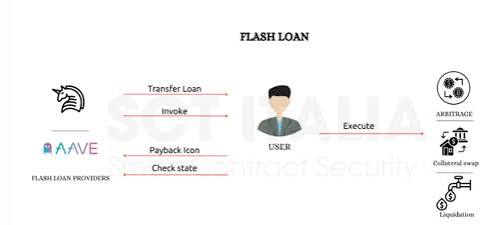
Typical loans involve providing some type of collateral. A bank might require property, savings or some other asset. Flash loans do not do that.
The protection is provided by the transaction on the blockchain. The loan has to be borrowed and repaid in one transaction.
The transaction may fail when the borrower has failed to return the due amount. The loan, therefore, is not technically on the balance sheet as a loan.
This gives users the ability to utilize a significant quantity of liquidity for an extremely short time.
How Do Flash Loans Work?
Flash loans rely on smart contracts. These are blockchain programs that automatically execute rules when specific conditions are met.
The process can be broken down into a few simple steps.
The first step is for a user to discover a DeFi protocol that has sufficient liquidity. The user will then ask for a flash loan of a particular amount of cryptocurrency.
Then, the smart contract transfers the money to the user’s transaction.
The user can then utilize that cash for a specific approach. This can be some sort of trade, refinancing debt, collateral swapping, or any other supported DeFi activity.
This user then has to repay the loaned sum with the fee.
Once all goes well, the transaction is complete. If the user is not able to pay the amount that is due, the transaction can be rolled back.
This can all occur within a single blockchain transaction.
Why don’t Flash Loans need Collateral?
This is probably the most interesting part of flash loans. In a normal loan, a lender is required to be protected when a borrower defaults on a loan. It’s that protection that’s provided by collateral.
Flash loans are done differently.
The loan is subject to only one atomic transaction. Simply put, it is the transaction needs to occur all together.
Imagine that you are in a situation where you must enter into a three-stage contract:
Borrow → Use → Repay
The transaction is not completed if the repayment step cannot be performed.
This eliminates the requirement of traditional collateral, as is the case with conventional loans.
This doesn’t imply that flash loans are free of risks, however. There are still vulnerabilities in the protocols and smart contracts used.
What Are Flash Loans Used For?
Flash loans can support several activities within DeFi.
Arbitrage
One of the most popular uses is, for example, arbitrage.
The price of an asset can differ slightly across two decentralized exchanges.
For instance, let’s say that there is one exchange that offers ETH at $3,000 and another exchange that quotes it at $3,030.
Flash loan is a mechanism that can be used by a trader to borrow money. They can purchase ETH at the lower price and sell it at the higher price.
The gap could represent a profit once fees, gas expenses and other expenses are taken into account.
These opportunities can vanish, though, in a flash. There can be other traders and automated bot that will be bidding against you for the same price difference.
Collateral Swaps
One of the other ways in which a flash loan might be useful for users is to enable them to swap the assets backing their DeFi position.
For instance, one may want to change one crypto asset for another. Flash loan can be used for providing the liquidity for the swap for a few moments.
After the process is done, the loaned money is returned in the same transaction.
This can sometimes be more effective than shutting down and opening a position down individually.
Debt Refinancing
The other is transferring of debt between different DeFi platforms.
A user can take out a loan using one lender and get better terms from another.
A flash loan may be able to help you pay back your existing debt. The position of the user can then be transferred to another protocol.
The exact process will depend on the platforms involved.
Liquidations
In some liquidation methods, flash loans may be employed.
The borrowers might need to liquidate their positions when they do not have adequate collateral on the DeFi protocol.
Temporary liquidity can be used by a trader to acquire an asset for or repay an asset from the liquidation. A flash loan can be paid back before the end of the transaction, if it creates enough value.
What are the dangers of Flash Loans?
While flash loans provide flexibility, they also carry risks.
Smart Contract Vulnerabilities
Smart contracts play a crucial role in flash loans. A protocol might be vulnerable to an exploit if a coding mistake is made.
That’s why audits and security testing are crucial in DeFi.
Price Manipulation
Some DeFi projects use price data to calculate the asset value.
A strong price mechanism is used when a protocol lacks a large influx of capital, which may not affect the price.
The attacker would then be able to use the manipulated price to make another transaction.
That’s why flash loans are frequently mentioned when referring to DeFi exploits.
It is important to note that the flash loan isn’t always the flaw. The issue could be a fault in another smart contract or pricing system.
Gas Fees
The network fee is an essential component of blockchain transactions.
A flash-loan strategy might seem to make sense on paper, but lose money once gas fees are taken out.
This is particularly significant in the case of a small profit potential.
Slippage
The prices may vary during the trading process.
However, a trader can end up paying a higher price for an asset than they bargained for due to the lack of liquidity in the market or due to a swift change in market price.
This can cut down on, or even eliminate, the anticipated profit.
Flash Loans vs Traditional Loans
Flash loans are not typical or conventional loans.
| Feature | Traditional Loan | Flash Loan |
| Collateral | Often required | Usually not required |
| Repayment | Over a set period | Same transaction |
| Main provider | Bank or lender | Smart contract |
| Credit check | Often required | No traditional credit check |
| Main use | Long-term borrowing | Short-term DeFi transactions |
A traditional loan is a loan that provides a person with funds for a much longer time.
A flash loan gives a short-term temporary liquidity to a certain transaction on the blockchain. Flash loans are not intended to be a substitute for mortgages, auto loans, or typical consumer loans, then.
Why Flash Loans Matter to DeFi
Flash loans show how blockchain technology can change the way financial transactions are structured.
Traditional finance can be lengthy and involve multiple intermediaries. DeFi protocols can merge various financial transactions into a single programmable transaction.
For instance, a user can borrow money, swap an asset, pay back a loan, and return the borrowed asset in one transaction. Such automation is hard to obtain with traditional lending systems.
A flash loan is thus a prime example of one of the core concepts of DeFi, which is the idea of creating financial services directly in the software of the blockchain.
The Future of Flash Loans
As the blockchain infrastructure evolves, flash loans are expected to continue to play a significant role in the broader DeFi landscape. Better smart-contract security, improved price oracles, lower transaction fees, and more liquidity will be critical in shaping their future.
Additionally, new DeFi applications might generate more demand for temporary liquidity. More use will do nothing to eliminate the risks, however. Flash-loan methodologies can be quite sophisticated, and a poorly engineered protocol can be susceptible to attacks.
With the technology, as with any technology, it is as important for users to be familiar with it as it is for them to be aware of the benefits it offers.
Final Thoughts
Flash loans are a unique way to borrow. They can help users to access cryptocurrencies without having to put up any collateral, as long as the money is returned within the same blockchain transaction.
These can help with arbitrage, collateral swaps, debt refinancing, and liquidation strategies.
Meanwhile, they pose dangers. A transaction may be impacted by a smart contract weakness, price manipulation, gas fees, and slippage.