

For years, DeFi has been presented as a challenge to the traditional financial system. But proving that financial services can run on blockchain networks is very different from proving they can compete with institutions that have spent decades building liquidity, regulation, risk controls, and customer trust.
This is where the DeFi discussion gets interesting. Its greatest strength may not be the elimination of banks, but how financial services are constructed. Open protocols are used to integrate lending, trading, liquidity and settlement into a programmable financial system open to the users. In traditional finance, transactions typically have to go through multiple intermediaries, but this is not the case in decentralized finance.
However, there are some challenging trade-offs to be made going with the strengths of DeFi. This openness that fosters innovation can also leave users vulnerable to exploits in smart contracts, fluctuations in underlying collaterals, governance issues, and weak consumer protections.
The question is not whether DeFi can be able to replicate traditional financial products, but rather how. Whether decentralized infrastructure can provide them with sufficient reliability, scale, and resilience to be a viable alternative.
Why DeFi Is More Than Just Decentralized Finance
One of DeFi’s most important characteristics is not simply that transactions happen on a blockchain. It is that financial applications can interact with one another.
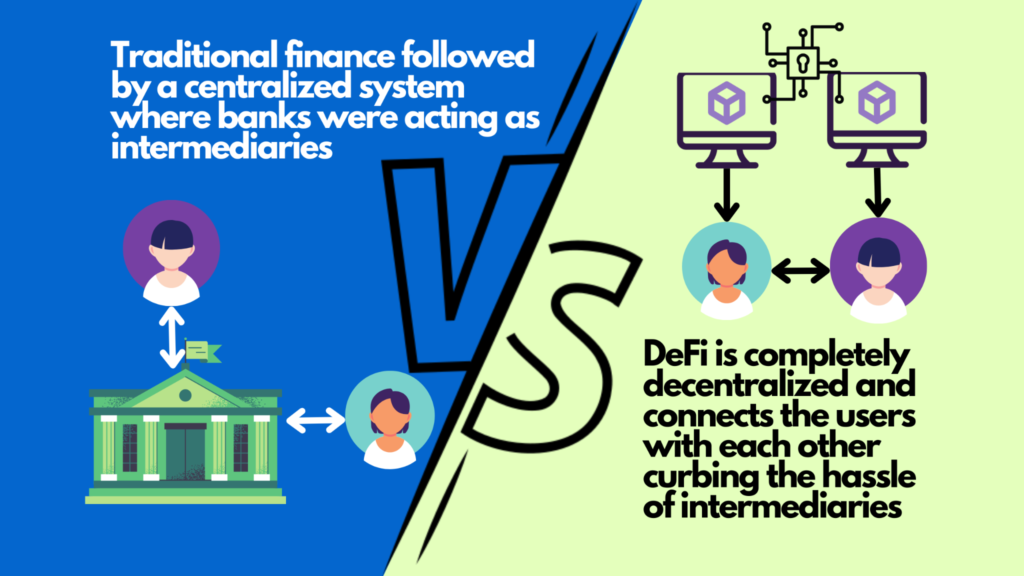
Typically, traditional financial institutions are installed in isolated systems. Each bank, brokerage, exchange, clearing house, and payments provider could have a different database, process, compliance, and settlement system.
DeFi protocols can be built so that they can directly communicate with each other. This provides the opportunity for what is sometimes known as “Money Lego. One protocol can offer you lending, another trading, another liquidity and another asset management. These functions may be able to be combined into one by the user without having to establish separate relationships with multiple financial institutions.
That alters the ways in which financial products can be designed. Developers can create applications based on existing protocols rather than a financial company creating a closed product and controlling the entire customer experience.This may help financial innovation become more modular eventually.
Composability can be a risk, though. A failure in one component of a system can cause failure in other components if multiple protocols rely on each other. The interconnectedness of DeFi can thus be a disadvantage in times of market stress.
DeFi Removes Intermediaries, Not Risk
The DeFi-versus-TradFi comparison gets more complex here. DeFi protocols may have different risk management strategies than traditional financial institutions.
A bank can evaluate the income, employment, credit rating, assets and repayment capability of a borrower. The same cannot be said for DeFi lending markets, which can’t assess the same attributes, especially when transacting with pseudonymous blockchain addresses. Instead, a lot of DeFi lending platforms rely on collateral.
A borrower who desires $50,000, say, may be asked to provide much greater than $50,000 worth of digital assets as collateral. Auto liquidation could start when the collateral drops below a predetermined level. This provides a strong method of automated risk management, although it comes with its drawbacks.
Collateral values may decline very quickly during a volatile market crash. Liquidations can speed up selling pressure and liquidity could be harder to come by just when it is needed most.
Traditional finance has a different set of systemic risks and risk-management instruments are focused on institutions, legal agreements, credit assessment and central counterparties.
Instead, DeFi offers alternative ways to do so, such as using collateral, code, and market incentives. Both models involve no risk removal. They share it with varying distributions.
The Bigger Test Is What Happens During a Crisis
During normal market conditions, DeFi can appear to be a very efficient way to work.
Transaction settlements can occur rapidly. Liquidity can be transferred between protocols. Interest rates may be variable. A user can place and conduct trades in a market without having to wait for the financial institution to approve each and every transaction.
- The more difficult test is when something goes wrong.
- What are the consequences of a successful exploit of a smart contract?
- What happens if a stablecoin fails to fulfil its purpose of being stable?
- What occurs if you don’t have any liquidity?
- What if multiple interrelated protocols simultaneously release positions as they unwind?
The answers to these questions are important as financial systems are judged by how efficiently they function in normal times, but also by how they function in times of stress.
While DeFi’s automated framework can limit some types of human involvement, it can also cause problems to accelerate.
DeFi Still Has a Distribution Problem
Technology isn’t the key to mass adoption. It has been decades since traditional financial institutions have developed relationships with customers, merchants, businesses, governments, and other institutions.
They offer easily recognizable interfaces, customer support, legal protection, compliance systems, and tried and tested ways to rectify errors.
With DeFi, there is typically a higher degree of responsibility for the individual.
Users might need to handle private keys, approve smart-contract transactions, keep track of network fees, evaluate protocol risks, and decide if a specific application is reliable.
These steps might be feasible to those who are already familiar with cryptocurrencies.
For those using the mainstream, they may be an unnecessary hindrance.
In order to eventually go head-to-head with traditional finance, the user experience of DeFi will need to be a lot easier, and users must still be made aware of the risks involved.
Traditional Finance Is Already Adapting
Perhaps the biggest challenge to the idea of “DeFi versus TradFi” is that traditional finance is not standing still.
Banks, asset managers, exchanges and payment companies are looking into blockchain settlement, tokenized assets, digital currencies, and other on-chain infrastructure.
Meanwhile, DeFi developers are facing many of the issues that have been tackled by traditional finance over the past decades, such as compliance, risk management, liquidity, governance and consumer protection.
The two worlds are thus heading towards one another.
A regulated custodial environment could be combined with blockchain settlement in a future financial product. The tokenized asset may be traded on on-chain infrastructure without the need to be tied to traditional financial institutions.
This is a system where users don’t even need to pay attention if it is DeFi or TradFi.
They will be concerned with its cost, speed, availability, transparency, reliability, and safety for the purpose.
What Would Make DeFi a Serious Alternative?
DeFi doesn’t have to be successful in all financial markets.
It must prove that decentralization does lead to tangible benefits in the areas where it is used.
This may result in quicker settlement, global liquidity, open access, programmable financial products, reduced friction between applications, and new ways for users to engage with markets.
However, all those gains rely on the ability of DeFi to enhance security, scale to accept higher transaction volumes, offer superior user experiences, and function inside of viable regulatory frameworks at scale.
The most critical benchmark could then not necessarily be the amount of money flowing into DeFi in a crypto bull market.
It could be that people are just sticking with the decentralized financial systems because it addresses issues that conventional financial systems can’t.
Wrapping Up
Berndtsson does not think it’s necessarily the best approach to fully replace banks with DeFi. Rather, it might be more effective in altering the design, delivery and access of certain financial services.
DeFi has already shown that things like lending, trading, providing liquidity, and settlement can be created around blockchain networks and programmable software. The real challenge for these systems is now to provide the same capabilities in a more secure, reliable, accessible and resilient way, outside of times of high market speculation.
Thus, the future of finance might not be as uncomplicated as what a lot of people think it will be between DeFi and traditional financial institutions. It may be an incremental process of other financial models competing, adapting, and finally co-existing with each other.
Traditional finance consists of trusted institutions, infrastructure, capital pools, and regulation. DeFi introduces open participation, programmable applications, composability and borderless blockchain networks.
Rather than one system completely replacing the other, the financial infrastructure of the future may combine elements of both.