

Bitcoin On-Chain vs Lightning Transactions highlights two important ways to send value using Bitcoin. Both methods use BTC, but they operate differently and serve different purposes.
An on-chain Bitcoin transaction is recorded directly on the Bitcoin blockchain, providing secure settlement, public verifiability, and the protection of Bitcoin’s decentralized network. In contrast, Lightning Network transactions take place off-chain through payment channels, allowing users to send Bitcoin much faster and often at a lower cost. Understanding Bitcoin On-Chain vs Lightning Transactions helps users choose the right method based on their needs, whether they prioritize on-chain settlement security or fast, low-cost everyday payments.
What are on-chain Bitcoin transactions?
An on-chain Bitcoin transaction is a transaction that is broadcast to the Bitcoin network and becomes part of the Bitcoin blockchain. It’s the native payment system of Bitcoin and the base layer, with which other transaction layers can function.
Bitcoin’s underlying architecture can be defined by a number of crucial features. The more confirmations a transaction gets, the more difficult it becomes to undo the transaction, blockchain transactions are publicly verifiable, and there is no central authority managing the blockchain.
These properties are realized in Bitcoin by having a decentralized network of nodes and miners. All nodes check transactions and blocks to ensure they follow Bitcoin’s rules, and all miners compete by adding valid blocks by solving a proof-of-work problem.
There are trade-offs, though, in this type of security design. On average, Bitcoin blocks are generated every 10 minutes, and each block is able to carry only a certain amount of transaction data.
If demand for block space grows, users can compete with each other by bidding for the space at higher prices. If the demand for block space grows, users can compete with one another by paying higher prices for the space.
This can sometimes mean that confirmations for on-chain transactions will take longer or cost more than the user expects.
What is the Lightning Network?
The Lightning Network is an L2 solution that runs atop of Bitcoin. It was created to overcome some of the limitations of the base layer, such as fees, scaling, and transaction speeds.
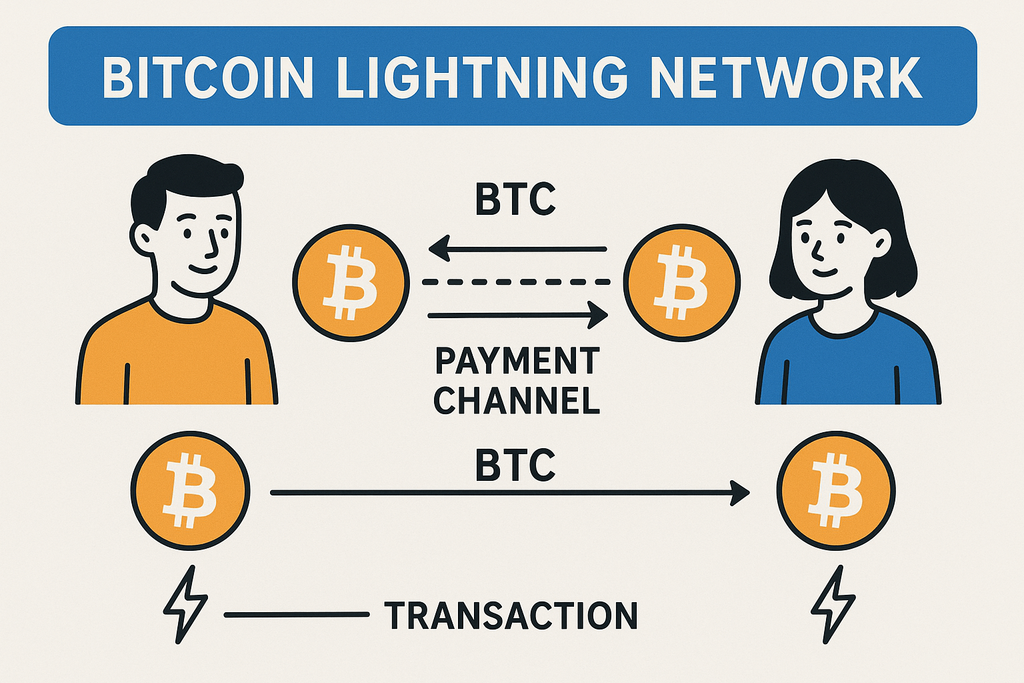
Unlike Bitcoin, Lightning enables users to conduct payments via payment channels that are not on the blockchain.
Opening a Lightning channel is an on-chain transaction that is used to lock up Bitcoin in a channel. After the channel is set up, players are able to trade Bitcoins without having to log each transaction on the blockchain.
The final account balance of the channel can be settled on-chain when it is closed.
This forms an important relationship between the two layers. Bitcoin is not a product of lightning. It is utilizing BTC and finally depends on Bitcoin’s base layer for its fundamental settlement and security.
Bitcoin On-Chain vs Lightning: Key Differences
| Feature | On-Chain Bitcoin | Lightning Network |
| Layer | Bitcoin Layer 1 | Bitcoin Layer 2 |
| Speed | Around 10 minutes per block on average | Usually near-instant |
| Fees | Variable and demand-dependent | Generally very low |
| Settlement | Directly on Bitcoin’s blockchain | Settled through channels, with on-chain settlement when needed |
| Scalability | Limited by block capacity | Designed for high-volume payments |
| Privacy | Transaction details are publicly recorded | Individual payments are generally not recorded on the public blockchain |
| Minimum payment | Subject to Bitcoin’s on-chain dust rules | Can support very small payments |
| Liquidity | No channel liquidity required | Channel liquidity is important |
| Best use case | Large transfers and final settlement | Small, frequent, fast payments |
How Bitcoin’s Base Layer Creates These Trade-Offs
The reason for Bitcoin’s comparatively slow transaction processing is logical. It’s built in such a way that ordinary users can independently verify the blockchain, rather than relying on a centralized authority.
This is the average time period between blocks, which needs to be a few moments to permit the network to remain in sync and to restrict block data to steer clear of an unnecessarily large blockchain to be saved and verified.
These options reinforce decentralization and at the same time slow down throughput.
Bitcoin employs a fee system instead that is based on the open market. Transactions vie for space in the block, and the block miner typically chooses the higher fee per transaction to be included in the block. If the demand is low, fees may be low. They may be quite high during certain periods of congestion.
This is not as convenient for day-to-day payments. If the user has to wait for confirmation, it is not efficient to pay for a small transaction, nor is it efficient to pay a fee that is a large percentage of the transaction.
To solve this problem, Lightning transfers appropriate payments from the base layer.
How Lightning Transactions Work
There are several steps in a simplified Lightning payment process.
First, a channel is opened. Bitcoin is dedicated to a payment channel via an on-chain transaction.
Second, payments are off-chain. Participants are able to update their balances without broadcasting all the payments to Bitcoin’s blockchain.
Third, there is a routing of payments. Lightning channels can be chained to other channels, forming a network where payments can flow. Small fees may be charged for transactions to be forwarded by routing nodes.
Lastly, the channel can be closed. On-chain settlement for the accumulated activity can be done via the final balances that can be settled on Bitcoin’s blockchain.
In this way, numerous payments can be made without at the same time using up bitcoin’s block space for each payment.
Why Lightning is Helpful for Everyday Payments
Lightning is especially convenient in situations where speed and low transaction charges are important.
Consider purchasing a cup of coffee using bitcoin. An on-chain payment might need to wait for blockchain confirmation, and the transaction fee might not necessarily be proportionate to the purchase price. The payment can be processed in seconds or less with Lightning, making BTC more convenient for retail transactions.
Lightning can also be used to support:
- Micropayments
- Online purchases
- Tipping
- Gaming transactions
- Frequent transfers
- Subscription payments
- Cross-border payments
Since the network can handle transactions without all the payments being placed directly onto the blockchain, it is well suited for high-frequency transactions.
Why Use Bitcoin On-Chain?
On-chain deals are still significant as Lightning isn’t meant to supersede Bitcoin’s core layer.
For large transactions, BTC transfers to a cold wallet, use of services that don’t have Lightning, or direct on-chain settlement, on-chain Bitcoin may be more suitable.
If, for instance, the sender of a huge sum of BTC transfers it to long-term cold storage, they may prefer to use an on-chain transfer, as the goal is not to spend it quickly, but to settle it securely.
There are also some activities on the Lightning Network that need to be done on-chain, such as opening and closing payment channels.
Users should also be familiar with concepts like UTXO management. UTXOs are created and consumed by bitcoin transactions, and maintaining the efficiency of managing these becomes relevant to larger holders.
Lightning Liquidity Is an Important Consideration
The major difference between the systems is the liquidity.
On-chain Bitcoin doesn’t need payment channel liquidity. So long as the transaction is valid, it can be accepted by the network, even if the sender does not have a Lightning channel.
But liquidity on payment channels and payment routes is required for Lightning payments. If there is not enough liquidity on the path, then the payment can be thrown out.
This is where the infrastructure to handle channels, routing, and liquidity effectively becomes of critical importance to all Lightning users and businesses.
Privacy and Compliance Considerations
Bitcoin transactions are recorded on-chain in a public manner. The data of the blockchain is accessible to anyone and can be viewed, such as the transaction amounts, addresses, and timestamps.
Lightning provides more privacy for individual payments, as those typically aren’t visible as individual transactions on the open Bitcoin blockchain.
But privacy doesn’t translate to anonymity. Appropriate internal records and monitoring may be required for businesses using Lightning infrastructure.
On-chain transactions may be easier to analyze from a compliance standpoint due to each transfer being a distinct blockchain activity. Lightning needs a wider perspective, with channel openings and closures, routing activity, node information, and internal payment records.
Conclusion
Bitcoin on-chain and Lightning transactions are not two versions of Bitcoin. They are complimentary systems used to solve different problems.
On-chain Bitcoin is the foundation of decentralized security, public verification, scarcity and final settlement. Lightning extends on the top of it to offer faster, cheaper and more scalable payments.
The Bitcoin blockchain is still indispensable for large transactions and long-term settlements. Micropayments and high-frequency transactions can be much more efficient experience on Lightning.
| Feature | On-Chain Bitcoin | Lightning Network |
| Layer | Bitcoin Layer 1 | Bitcoin Layer 2 |
| Speed | Around 10 minutes per block on average | Usually near-instant |
| Fees | Variable and demand-dependent | Generally very low |
| Settlement | Directly on Bitcoin’s blockchain | Settled through channels, with on-chain settlement when needed |
| Scalability | Limited by block capacity | Designed for high-volume payments |
| Privacy | Transaction details are publicly recorded | Individual payments are generally not recorded on the public blockchain |
| Minimum payment | Subject to Bitcoin’s on-chain dust rules | Can support very small payments |
| Liquidity | No channel liquidity required | Channel liquidity is important |
| Best use case | Large transfers and final settlement | Small, frequent, fast payments |