
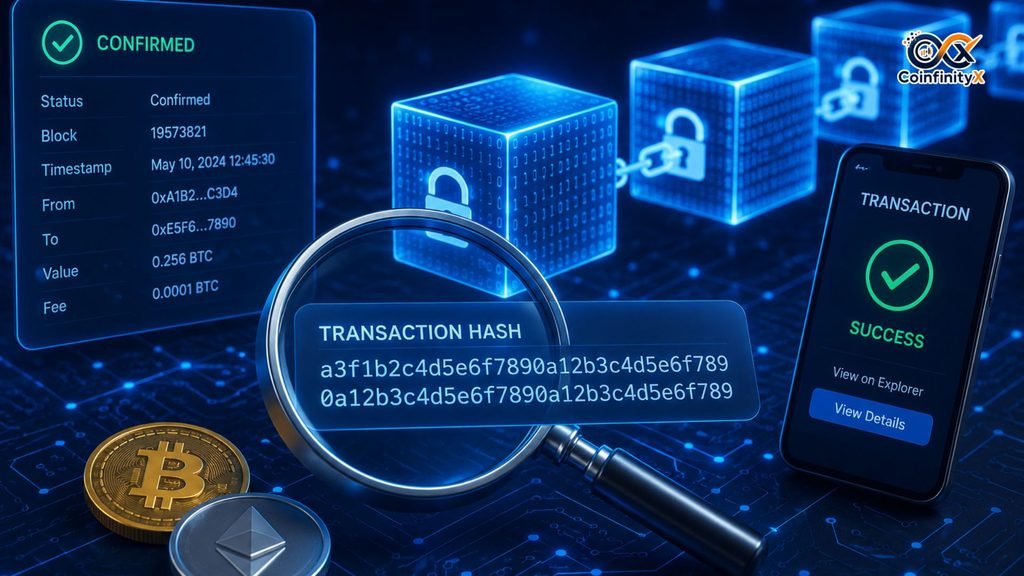
A crypto transaction hash is a unique string of characters used to identify a specific transaction within the blockchain. Each time someone sends or receives cryptocurrency, their wallet will generate a new hash. This hash can be found on any public block explorer and allows users to verify that their transaction has been successfully processed by the network.
While it is possible to send digital currency in just a couple of clicks, there is a very detailed log of each and every transaction on a blockchain. Therefore, if you would like to know whether your transaction has been completed, find out where your money has gone, or determine why a payment is delayed, then the best thing you can look up is the transaction hash.
A transaction hash acts as a unique digital identity for every on-chain transaction that is made; it can be used to track transactions across thousands and/or millions of other transactions in the blockchain.
Users are able to search the blockchain for a transaction using its transaction hash. After searching for a transaction, they will be able to see all information about that transaction such as whether or not the transaction was successful; who sent the funds; where the funds were received; how much was transferred; what fee(s) were paid; and how many times the transaction has been confirmed on the blockchain.
What is a transaction hash or TXID?
An on chain transaction will be processed by the blockchain protocol, which generates or derives a unique identifier according to the specifications of the blockchain network. The manner in which this process occurs and its specific format will depend upon the particular blockchain being used.
The differences between various blockchain networks should be emphasized. While all blockchain networks utilize some form of cryptography (hashing), they differ on how that cryptography is implemented, as well as on their internal structure. For example, some examples of these types of networks include; Bitcoin, Ethereum, Tron, etc.
However, for the majority of shoppers, it is a simple lesson:
A TXID can be used as a way to identify a specific transaction in a blockchain.
This is similar to how a reference number is used when making payments. Users don’t have to rely completely on the interface of their wallet or exchange for information about each transaction; instead, they can go to the correct blockchain explorer and look up each transaction using its TXID.
On the other hand, TXID’s are typically only generated for on-chain cryptocurrency transactions. Therefore, if an individual makes a purchase through a non-on-chain transaction such as a standard bank transfer or credit card purchase, they will not receive a blockchain transaction hash.
A Transaction Hash is Similar to a Digital Receipt
Suppose you were given the opportunity to transfer cryptocurrency into another wallet. After submitting the transfer request, your wallet will indicate that the transfer is currently in process (pending) until the transfer is added to the blockchain. At that point, the TXID created by the blockchain will allow you to see what happens to the transfer.
Utilize that TXID in a suitable TX explorer and you can view details about the TX including:
Know how to send and receive address information. Be aware of how you can send and receive address information.
- Amount transferred
- Transaction status
- Network fees
- Block information
- Timestamp
- Confirmations
The information displayed can vary depending upon which blockchain is being used.
When we talk about a transaction hash, we are talking about a unique identifier for each transaction on a blockchain. It is created by hashing all the data that makes up the transaction (the sender, receiver, amount transferred, etc.). This creates a fixed-length string of characters which represents the transaction. The purpose of this hash is to allow users to verify whether or not their transactions were successfully completed, or if there has been an error. This process is very similar to how you would create a digital signature for a document. You sign the document with your private key, creating a digital signature. Then, you can use your public key to verify that the digital signature belongs to you and that the document hasn’t been altered since you signed it. In the same way, when you make a transaction on a blockchain, you create a transaction hash. You can then use your public key to check that the transaction hash matches the one generated on the blockchain. If they match, then you know that your transaction was successfully processed. If they don’t match, then you know that something went wrong during the processing of your transaction.
As mentioned previously, there are various ways of generating transaction hashes on different networks; however, what is common to all these methods is that they each employ some form of cryptographic hash function which is vital to each of the respective networks.
The primary purpose of cryptographic hash functions is to take a set of inputs and generate a corresponding output based upon a predefined algorithm. Any changes to the underlying data that generated the original transaction will cause the resulting output to differ from the initial output.
In most cases, you don’t have to manually generate a transaction hash. Your wallet, node, or the blockchain protocol will automatically take care of that.
Also, please keep in mind that not every transaction hash will be a 64 character SHA-256. This may be true within the context of blockchain; however, there are many differences in how transactions are structured and what cryptographic methods are employed on each network.
All of them are similar in their requirements for referencing transactions, as they all exist on the network.
The reason that you should care about a transaction hash is because it is the way that you can verify that your transaction was actually completed and that it is on the blockchain. When you make a purchase or complete another type of transaction on a blockchain network, the network creates a unique identifier (hash) for that transaction. You can then use this unique identifier to check if your transaction has been successfully processed and added to the blockchain. If you find your transaction in the blockchain, then you know it went through successfully. If you do not see your transaction in the blockchain, then you know it did not go through successfully. In addition to being used to verify that your transaction has been completed, a transaction hash also serves as an audit trail. An audit trail is basically a record of all of the activity related to your transactions. This includes information about who made the transaction, when the transaction was made, how much money was involved, etc. This allows you to easily track the history of your transactions and ensure that everything is accurate. Finally, a transaction hash is used to protect your privacy. Because the transaction hash is completely random, there is no way for anyone to link it back to you. Therefore, no one will ever know that you completed a certain transaction unless you tell them.
Blockchain has the major benefit of allowing anyone to check their own transactions on the public network.
The transaction hash will make it very easy for you to locate a specific transaction.
Confirming the receipt of your cryptocurrency transfer
If someone has stated they sent money to your digital wallet and you cannot locate it within your digital wallet, how can you find out where it went?
The next time you take a screenshot, please request the TXID.
The right blockchain explorer can be used to check if a transaction exists, and what the current state of the network is.
Tracking Confirmations
Blockchain transactions may not be considered “confirmed” by wallets, exchanges, or merchants until the user’s wallet confirms that the transaction has been completed. The transaction will have a TXID which allows the user to be tracked.
The number of confirmations can differ between each type of block chain, exchange, wallet and payment provider. It does not mean that as soon as the transaction is on the block chain, that it will be credited immediately to all services.
Troubleshooting Transactions
The use of transaction hashes can be very beneficial for customers who have experienced issues with their transactions. When customers experience an issue with their cryptocurrency deposit/withdrawal being delayed/missing, they will likely need to provide the TXID (transaction identification number) to either the wallet provider or exchange. The TXID allows the customer support staff to locate the exact transaction that was delayed/lost instead of having to rely on screenshots or approximate times to help resolve the issue.
Providing the entire transaction hash or explorer information will help with your issue resolution.
Crypto Transaction Hashes: Finding Them A crypto transaction hash is a unique string of characters used by block chains to identify and track each crypto transaction. When you make a crypto transaction (e.g., purchase goods or services online using crypto, send crypto to another person, etc.), your wallet provider will automatically generate a crypto transaction hash for you. You can find this hash on the blockchain explorer for the currency that you used. For example, if you used Bitcoin, you would use a Bitcoin blockchain explorer. If you used Ethereum, you would use an Ethereum blockchain explorer. To use a blockchain explorer to find your crypto transaction hash: Go to the blockchain explorer for the currency that you used. Enter your wallet address into the search box. Look through the list of transactions associated with your wallet address. Find the transaction that you want to locate the hash for. Click on the transaction. The page that loads will contain the hash for that transaction.
The simplicity of this process will depend upon the specific wallet or exchange; however, most times it is an easy process.
To find out what happened with your transaction or withdrawal, first go into your wallet or exchange and look at the history of your transactions or withdrawals. You will need to locate the specific transfer and then click on it to see the information associated with it.
Check the field represented by an object like:
Transaction ID, TX ID, Tx ID, Tx ID, or Tx ID. This is the identifier that can be used to either copy it or select another option (such as “View on Explorer”).
The process for an external wallet is also the same; you can find the link to the blockchain record of the specific transaction.
It doesn’t matter what kind of explorer you use, as long as it has support for the network you are trying to view your transaction on.
Final Thoughts
A transaction hash may appear as a disorganized string of characters, however it is one of the most useful reference points within the cryptocurrency industry.
The ability for users to locate transactions, monitor confirmation status, confirm the validity of addresses and quantities, investigate late transaction occurrences, etc., as well as providing more specific information when contacting a currency exchange or wallet provider.