
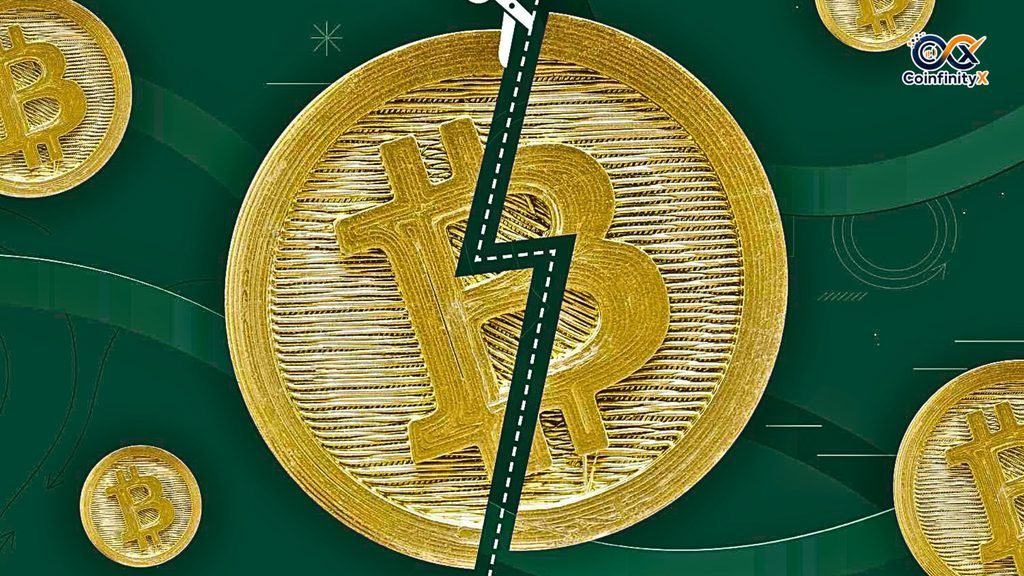
Bitcoin has a maximum supply of 21 million coins, but they do not all enter circulation at once. Rather, new BTC is emitted over time via mining and approximately every four years, the amount of new Bitcoin rewarded to miners is reduced by half.
This is referred to as the Bitcoin “halving”, and it is a key component of the Bitcoin supply system. Unlike a company or government or central bank deciding to implement a halving, it is part of the Bitcoin protocol and will be executed every 210,000 blocks. The last one was in April of 2024, when the block subsidy was halved from 6.25 BTC to 3.125 BTC.
Halvings decrease the rate at which Bitcoin is created, helping to gradually bring its supply closer to the cap of 21 million. They also have the potential to have a significant impact on miner revenue and can sometimes create investor attention due to the impact on Bitcoin’s supply and demand.
However, what are the consequences of a BTC halving, what was the reason behind its development, and is the halving of the mining reward truly influencing the price of bitcoin? Let’s take a closer look.
What is Bitcoin Halving?
Bitcoin halving is an event which is programmed in Bitcoin to cut the reward given for mining blocks in half.
Bitcoin is based on the Proof of Work consensus mechanism in which miners compete for the production of valid blocks using their computing equipment. If they manage to produce a block that is accepted by the network, then they can receive two types of reward.
Subsidy for blocks + transaction fees.
The block subsidy is a new BTC. This will be halved during a halving.
The event has nothing to do with cutting the quantity of Bitcoins in a person’s wallet in half. It does not also lower the market price of Bitcoin by half or reduce the transaction charges by half.
On the other hand, halving merely cuts the production of new BTC in half.
How Does Bitcoin Halving Work?
Bitcoin’s halving does not occur on any specific calendar date, but rather on a schedule determined by the number of blocks.
A halving takes place every 210,000 blocks. Bitcoin’s average block time is around 10 minutes, meaning a Bitcoin block is likely to be created in about 4 years.
The process can be simplified to:
Miners compete to create a block → Valid block = it is added to the chain → Miner gets reward in the form of subsidy and fees → After 210k blocks, reward halves.
No central organization has to declare or turn on the event.
Nodes are responsible for implementing the Bitcoin consensus rules, such as the maximum amount of new BTC that can be generated in a valid block.
Bitcoin Halving History
In 2009, Bitcoin’s initial subsidy for blocks was 50 BTC.
Since then, it has decreased as follows:
| Halving | Block Subsidy |
| Bitcoin Launch- 2009 | 50 BTC |
| First Halving- 2012 | 25 BTC |
| Second halving- 2016 | 12.5 BTC |
| Third Halving -2020 | 6.25 BTC |
| Fourth Halving- 2024 | 3.125 BTC |
| Next Halving- expected around 2028 | 1.5625 BTC |
The subsidy decreased from 6.25 BTC to 3.125 BTC per block in April 2024 due to the halving event. The next event will be at block height 1,050,000, which will once again cut the subsidy by half, to 1.5625 BTC. It is impossible to predict the exact time of its occurrence with much accuracy ahead of time, since the blocks aren’t produced at regular 10-minute intervals.
What is the reason for the halvings in Bitcoin?
The main purpose is to control Bitcoin’s issuance.
The protocol of Bitcoin has a cap of 21 million Bitcoins. S. coins are not released all at once, but Bitcoin releases new coins slowly over time via mining.
Over time, halvings slow down that process.
Think of a tap filling a container. The maximum water capacity in the container decreases as the water comes out of the tap. The container will keep filling, but it will fill more slowly.
Bitcoin works similarly.
The money supply can keep on growing but the growth rate can fall. This is significant. Halving does not mean that existing bitcoins are eliminated. This slows down the influx of new BTC.
How Does Halving Affect Bitcoin Miners?
Miners are the ones who suffer the most financially.
Imagine a miner managed to create a block just before the halving in 2024.Now imagine that miner successfully has created a block just prior to the halving in 2024. The subsidy for the block was 6.25 BTC.
Following the halving, it hit the price of 3.125 BTC. That’s a significant drop in subsidy revenues, all else equal.
Even though the mining business might be over, there are still costs to consider such as:
- Electricity
- Mining hardware
- Cooling
- Maintenance
- Facilities
- Other operating expenses – including employees and wages.
Lower income coupled with these expenses could make lower efficiency miners less profitable.
Bitcoin also has another system that enables it to adjust: mining difficulty adjustment.
Every 2016 blocks, Bitcoin mines for blocks at a rate that will adjust the difficulty to a rate that is roughly 10 minutes per block.
Thus, difficulty adjustment and halving serve different functions:
The new BTC issuance is controlled by halving. Adjustment Difficulty makes block production control easier.
Does Bitcoin Halving Make BTC Scarcer?
Yes, but in this particular way.
A halving does not cause a decrease in the supply of Bitcoins. Rather, it does the opposite of increasing the new supply entering the circulation through the block subsidy.
Pre-2024, the maximum amount of subsidy that could be rewarded for a valid block was as high as 6.25 newly issued BTC.
Subsequent to that period, the number rose to 3.125 BTC.
The next halving will cut it in half again to 1.5625 BTC. This continued depleting issuance coupled with Bitcoin’s capped supply of 21 million creates its digital-scarcity narrative.
Common Bitcoin Halving Misconceptions
The most common confusion is that someone’s BTC wallet becomes half of its total amount. It doesn’t. The halving is not the event that converts 1 BTC into 0.5 BTC if it’s owned prior to the event.
Another mistaken belief is that the halving of mining rewards should drive Bitcoin’s price into the stratosphere.The other erroneous belief is that Bitcoin’s price should double when mining rewards are halved. The block subsidy does not directly influence market prices; the market determines these.
There is also no precise four-year old calendar schedule for halving. The protocol does not have 210,000 years of blocks, but 210,000 blocks.
Last but not least, halving is not a complete stopping of mining rewards. This cuts the block subsidy in half, but allows miners to still earn transaction fees.
Why is it that Bitcoin halving matters?
Bitcoin halving is significant because it ties together a number of key facets of the network:
scarcity, mining, security, monetary issuance, and market expectations.
- It alters the profitability of miners’ operations.
- It slowly decreases creation of the BTC for the network.
- It gives market participants a highly-anticipated supply event, which can shape market expectations, but cannot predict the actual price.
- Most importantly, the halving is a testament to the fact that Bitcoin’s monetary issuance mechanisms follow a set protocol rather than being made by a central authority.
Final Thoughts
In short, Bitcoin halving refers to the law of the land that for each 210,000 blocks of the bitcoin blockchain, the mining subsidy for new bitcoins created is halved.
The march follows the narrative:
50 BTC → 25 BTC → 12.5 BTC → 6.25 BTC → 3.125 BTC → 1.5625 BTC
This process will slowly reduce the rate of issuance of bitcoin, bringing this network closer to its cap of 21 million coins.
A halving won’t affect balances of existing Bitcoins, nor will it directly influence transaction fees, and nor will it necessarily lead to a rise in BTC prices, it will only impact the profitability of miners and market expectations.