
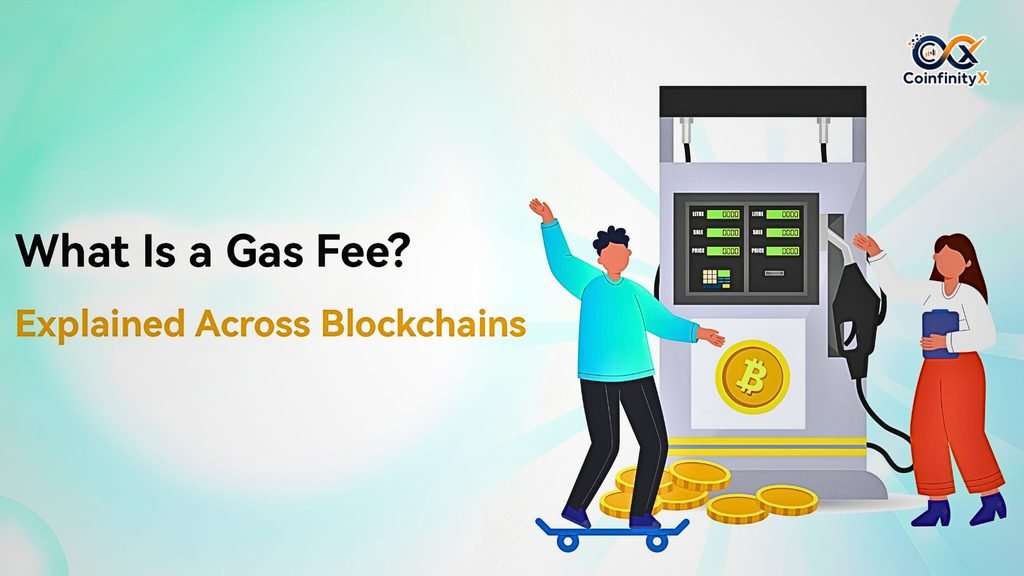
Sending cryptocurrency may seem effortless. You type an address, select a quantity, and confirm the transaction. However, the blockchain has to do some computation work before the transaction is added to the chain.
All of that work does not come free.
Most blockchain networks charge gas fees, or transaction fees, to users. Gas is used to understand the usage of network resources and transaction processing. It also deters spammers, and provides economic rewards for those who support the network.
When it comes to gas fees, it is particularly crucial for users to grasp the concept, particularly when dealing with networks like Ethereum, where virtually every action on the blockchain comes at a price.
What Are Gas Fees?
Gas is the amount of power used to execute the requirements of a blockchain.
Resources are used in each transaction of the blockchain. The network might need to sign and verify digital signatures, execute instructions of the smart contract, adjust balances, or store new data.
This work can be measured in a standardised way using the gas.
For instance, if you are transferring cryptocurrency from one wallet to another, it is pretty easy, and usually, not very computation-intensive. There can be multiple smart contract operations for a decentralized finance (DeFi) application, which can require more gas.
More complex tasks may involve more complicated token swaps, offering liquidity, minting digital assets, or launching a new smart contract.
Gas is charged to users with the designated cryptocurrency of the blockchain. For example, on Ethereum, transactions are done in ETH; and gas prices are usually priced in gwei, a small denomination of ETH.
Gas is thus somewhat like fuel. The more resources a transaction needs to use in the computation, the more gas it will use.
How Do Gas Fees Work?
There is a finite amount of computing power and space in a blockchain. Gas offers a way to apportion those resources among users.
Two important concepts are the gas limit and gas price. Gas limit is the maximum gas usage for an operation. Transactions involving more complex smart contract interactions typically will consume more gas than regular transfers.
A transaction can fail to execute if it lacks sufficient gas in an Ethereum transaction. The calculation facilities used are not without cost, however, and the user may still have to pay for the work done prior to the failure.
The gas price is the price of each unit of gas used by the user.
In addition to the base fee, there is also a priority fee for modern Ethereum transactions.
The fee varies by protocol based on demand for blocks. This part of the transaction fee is destroyed, which is equivalent to being “burned.
The priority fee is more of a tip. It adds an extra incentive for a validator to add the transaction.
This means that users can increase their priority fee if they wish to speed up transactions during periods of heavy use.
A Simple Gas Fee Example
Suppose there are two people who wish to make transactions on the Ethereum system.
The first one just transfers ETH from one wallet to the other. The second person utilises a DeFi application which necessitates multiple smart contract operations.
The 2nd transaction will presumably require more gas, as more computation work is required for the network.
The overall cost of the transaction ends up being a function of two general parameters: the amount of gas used in the operation and the cost of the gas used in the operation.
This is because two transactions at the same time can have vastly different fees.
It also provides an insight into why it would be misleading to look at the volume of cryptocurrency being moved. It is not required that more computational work be needed to send $10,000 worth of an asset than $100. The operation performed is more important than the dollar value.
Why Do Blockchains Need Gas Fees?
The cost of gas is not just a burden for the users. They serve a number of purposes.
The first is to manage limited network resources.
Public blockchains are public. If there were no transaction fees, one could make a meaningless series of transactions and “take up bandwidth. Spam is more costly if it’s charged for computation. If someone tried to use the resources to destroy the blockchain they would be continually swamped by costs.
Another important factor associated with the economic incentive for transaction processing is gas fees.Validators provide the computing resources and capital to maintain the blockchain. Validators can be rewarded for including and processing transactions with priority fees.Priority fees can reward validators for including and processing transactions.
Gas is the economic incentive between gas consumers and network participants that help support the network.
Why do gas fees sometimes change to such high amounts?
The fee for transactions has also been seen to rise or fall in a busy blockchain, which any user of such a network will have noticed.
One of the primary reasons is network congestion.Blockchains are only capable of holding so much. The capacity of the available block space is limited to a certain amount of transaction activity. The more the need, the more the users compete with that limited capacity. This may drive up transaction costs.
When network activity increases dramatically, as seen during large token launches, periods of heavy market volatility, and popular decentralized apps, these surges can lead to congestion.These surges can result in network congestion with large token launches, periods of heavy market volatility, and popular decentralized apps.
Another factor is the complexity of the transactions, since some are more complex than others.
Simple transfer of cryptocurrencies involves comparatively less amount of computation. It takes a lot more to support a transaction that involves multiple smart contracts.
For more complex DeFi operations, there can be several calculations and state changes in one transaction. The more the computer works, the more gas will be used.
The final cost can be especially high during the times when an involved transaction occurs when there is already significant network demand.
What can users do to lower gas fees?
- One of the easiest is the timing of the transaction. The amount of network activity varies during the day. Those who have non-urgent business can check the situation of gas and wait until the demand is low.
- One other rapidly growing development is Layer 2 networks. In the context of Layer 2 scalability, the term refers to solutions that optimize block activity, but will still use a blockchain for final settlement or security.
- Optimistic rollups and zero-knowledge rollups are innovations that can group numerous transactions into a bundle before they are submitted to the main network. Costs can be distributed across many transactions, rather than each user paying for the entire amount of work performed on the base layer. This can significantly cut down on each user’s payment of the fee.
- Smart contract optimization is another way for developers to lower gas usage.Smart contracts should perform fewer operations and unnecessary changes to the state. By making the blockchain’s work easier, the transaction costs for application users may be reduced.
Gas Fees and Decentralized Applications
Gas becomes critical when users start using the blockchain beyond transfers of cryptocurrencies. Smart contracts play a crucial role in the development of DeFi applications. Several operations are required for token swapping, borrowing crypto, providing liquidity and interacting with other decentralized protocols.
All the operations use network resources.
Therefore, it is important for the users to review the estimated transaction fee before confirming the interaction with a smart contract. The profit potential of a transaction can be reduced by network costs.
This is the same issue for businesses and institutions. For those organizations that are doing a lot of blockchain transactions, gas will be an element of their business which they should take into consideration.
Are Gas Fees the Same on Every Blockchain?
No.
Each blockchain network has its own methods for transaction fees, network size and incentives for validators.
Though gas is a key attribute of Ethereum and EVM-compatible networks, the concept of fees for network usage is prevalent across various public networks.
Private and permissioned blockchains can be distinct. Since they are not open public networks, they may not need the same sort of economic protection from spam as open networks.
However, while some networks have transaction fees, they can vary widely in terms of how they are calculated. Users should therefore be aware of the fee model of the specific blockchain they are using, and not assume that all blockchain networks operate in the same way as the Ethereum network.
Conclusion
Gas fees are an integral component of multiple blockchain networks.
They cost money for computational resources, help to moderate demand for scarce block space, prevent spam, and help provide economic motivations for transaction processing.
Final costs may vary based on the complexity of the transaction and network demand. Simple transfers typically require less gas, and more if sophisticated smart contract interactions are performed.
While high fees are still a challenge, Layer 2 networks, optimized applications, and strategic transaction timing are some factors that can help lower costs.