

- The Illinois Crypto Tax introduces a 0.2% tax on most crypto transactions starting January 1, 2027.
- Major exchanges must collect and report the tax on transfers, including self-custody withdrawals.
- Industry groups plan legal action, arguing the measure unfairly targets digital assets.
In June 2026, Illinois will be the first state in the United States to levy a direct tax on cryptocurrency transactions without targeting profits, but rather the act of trading digital assets. On June 16, 2026, Governor J.B. Pritzker signed Senate Bill 3019 into law, sparking a wave of shock and dismay throughout the country in the crypto industry. This article provides Illinois residents, cryptocurrency investors, and businesses with all the information they need to know about this unprecedented state-level crypto tax.
What Is the “Illinois Digital Asset Tax”?
The Illinois Digital Asset Tax Act, as part of the state’s $55.9 billion FY27 budget, levies a 0.2% tax on all “digital asset business activity. The bill defines this as “any one instance of exchanging, transferring or storing a digital asset in the course of a business or as agent for a customer.
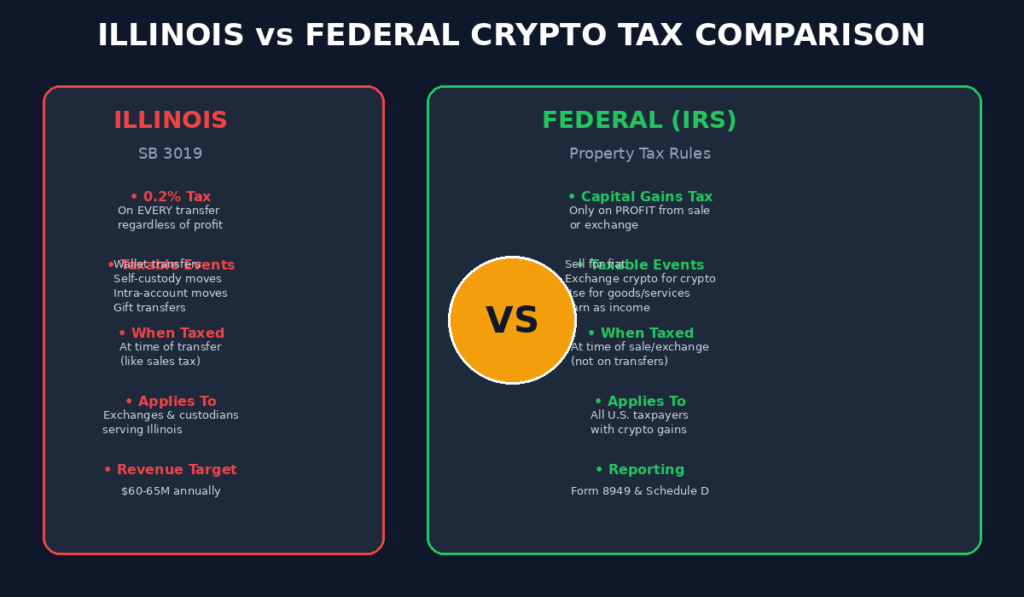
Compared to other jurisdictions, this is a stark change from the way crypto currently is treated. The majority of states (and even the federal government) do not tax cryptocurrencies until they are realized as a profit (capital gains tax). Illinois is taxing the sale regardless of any profits or losses. “Most crypto tax laws are focused on what you earn, but that’s not the case in Illinois, where they’re focusing on “the mere act of moving your own crypto from one place to another,”” says Forbes.
The tax is levied against entities with gross receipts from Illinois customers of at least $100,000 over a rolling 12-month period, and/or whose operations are located in Illinois. The state estimates the tax will provide about $60 – 65 million in additional revenue per year.
So, when does the Illinois Crypto Tax go into effect?
The tax will apply from January 1, 2027. This will allow Illinois residents and businesses around 6 months to prepare, plan crypto strategy, and potentially consider legal or legislative avenues prior to the law going into effect.
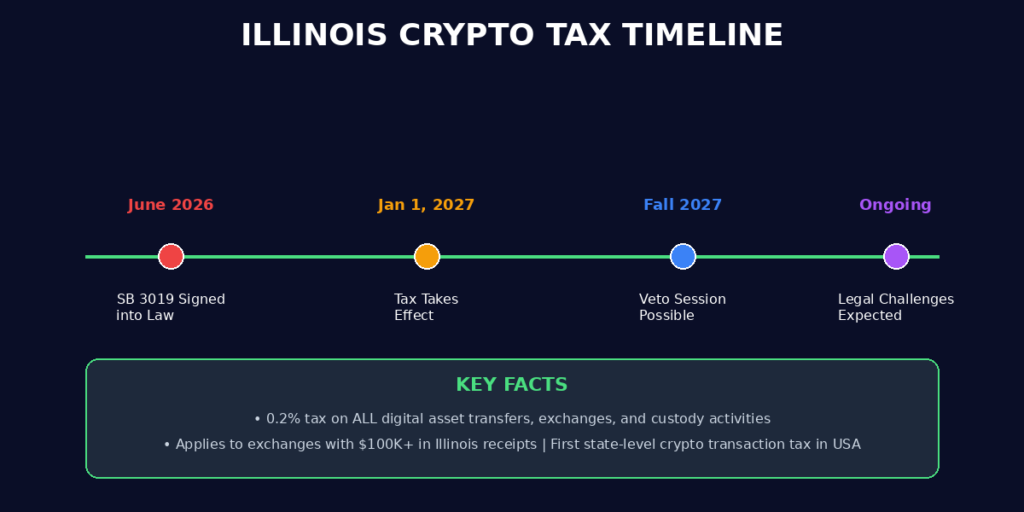
But may be limited legislative window to change. The Illinois General Assembly voted to adjourn after passing the budget and there is a veto session coming up in the fall—but Gov. Pritzker has not shown any signs of wanting to veto the digital asset tax provision. The Crypto Council for Innovation has written a letter to the governor asking for a veto, which is still to be determined.
Which transactions are subject to the tax under SB3019?
Under SB3019 in Illinois, the definition of “transfer” is meant to be as broad as possible and include much more than just the sales. The following activities could be subject to the 0.2% tax, says Forbes:
Transferring cryptocurrencies from an account to another account within the same exchange (such as transferring crypto from a trading account to a vault on Coinbase)
Moving cryptocurrencies to self-custodial wallets (cold storage or hardware wallets such as Ledger)
Gifting cryptocurrencies to friends and family
Paying someone a merchant for products/services with crypto.
Moving from one exchange to another or from one platform to another
But regular account maintenance – activities which do not generate revenue – may result in taxable activities being reiterated over and over again. “The only thing that happened was that you moved your own property,” said one crypto tax expert.
The exchange or custodian is responsible for collecting the tax, not the individual. The broker takes 0.2% out of the transfer amount and sends it to the Illinois Department of Revenue, similar to how sales tax is taken at check-out.
The Double-Taxation Problem
One of the most attacked features of the Illinois crypto tax is the prospect of taxes on the identical holdings being levied multiple times, even thrice. As Forbes points out,
Imagine you transfer $1,000 of bitcoin from your trading account to a vault on the same exchange.Let’s say you transfer $1,000 of bitcoin from your trading account to a vault on the same exchange. Your broker gets $2 (0.2%) and $998 is deposited in the vault. Now transfer that $998 to your wallet that you control yourself. The same 0.2% applies, and it is an additional $2 or so. The same crypto, which was transferred twice, during a normal workflow, is taxed twice. There was no increase in gain. There was no income generated.
This stacking effect can severely impact the wallets of active traders, DeFi enthusiasts, or those who regularly transfer funds between wallets and platforms for security or organizational reasons.
Which Platforms and Exchanges are impacted?
The tax liability is due on any centralized exchange or custodial service that:
Physically operates in Illinois, OR
Generates income of more than $100,000 from Illinois customers over a 12-month period.
This threshold is so low that it can’t be missed that it includes close to all of the big exchanges that serve Illinois residents, such as Coinbase, Kraken, Binance.US, and Gemini.
If you live in Illinois, this could mean your tax bill isn’t sent directly from the state. Rather, you’ll only be charged a 0.2% fee on each transfer, withdrawal, or movement of crypto on an approved platform.
The industry reacted to the ruling, while legal challenges were filed.Industry comments and court action followed.
The crypto sector is backing down with a vengeance. But that was a dramatic change from Illinois’ previous Digital Assets and Consumer Protection Act, which Miles Jennings, CEO of the Crypto investment group Andreessen Horowitz, had hailed as “a constructive approach to blockchain technology.
How Illinois Crypto Tax Rules compare with Gov. Tax Rules
The IRS considers cryptocurrency a property, which means you are only responsible to pay taxes when you:
Convert crypto to cash
Navigate to the exchanges and trade one cryptocurrency for another.
Opt for cryptocurrency purchases instead of goods or services.Make purchases with crypto instead of goods or services.
Earn crypto as income
In none of these cases is tax levied on transfers of assets from one wallet that you control to another. The Illinois tax breaks between here and there existional benefit and never accrues from transfers, although it is imposed as such.
Further, the Infrastructure Investment and Jobs Act of 2021 (IIJA) provides Federal reporting obligations for crypto brokers, which come into effect in 2026 – 2027. Now, Illinois will have two layers of compliance—federal capital gains reporting and state transaction taxes.
Here are a few tips for Illinois crypto investors before Jan. 1, 2027.
Illinois citizens have a window to prepare due to the tax coming into effect 1/1/27. Here are some action points to keep in mind:
1. Minimize Unnecessary Transfers
Gather all your cryptocurrencies in less wallets before the deadline and the same applies to the exchanges.Before deadline grab as many cryptos as possible in fewer wallets and also few exchanges. All transferals after January 1st will be 0.2%.
2.Learn about Your Exchange’s Illinois Policy.
Determine if your main exchange has stated plans for compliance with SB3019. Some platforms have a limited scope of services for residents of the State of Illinois, due mainly to the compliance burden.
3. Maintain Detailed Records
Maintain complete cost basis for all wallets/accounts. Cost Basis tracking is already a federal mandates, yet additional layer of transfer taxes makes it an even important tracking.
4. Monitor Legal Developments
Be alert to suits or legislation which might postpone or alter this tax. Several industry groups, including the Crypto Council for Innovation, are doggedly litigating.
Seek advice from a Tax Professional
A tax professional who specializes in cryptocurrencies is strongly recommended, especially in such a layered and complex state + federal tax situation. School programs like the University of Illinois Tax School can provide information on digital asset reporting guidelines.
Conclusion
The 0.2% digital asset transaction tax introduced in Illinois symbolically marks a significant change in U.S. state digital asset laws. SB3019 imposes a cost and compliance framework on cryptocurrency transactions that is not what has been used in the traditional financial services industry. The next six months will be crucial for Illinois residents and exchanges operating here, from conducting preparations and trying out a legal strategy to possibly moving crypto operations.
Regardless of whether this law is destined to become law or may spur other states to follow suit, it did foreshadow a new era of crypto taxation in the United States — and Illinois is in the midst of it.
FAQs set of commonly asked questions/answers.
Q1: Will the Illinois crypto tax apply to transfers of crypto by me among my own wallets?
Yes. SB3019 defines a “transfer” as the movement of crypto between two accounts held at the same exchange or movement to a self-custodial wallet, like MetaMask or a Ledger account. The tax rate is 0.2% even if you did not make any profit.
Q2: Will I have to file the Illinois crypto tax myself, or does the exchange handle it?
The exchange / custodian will be responsible for withholding and remitting the 0.2% tax to the state. There will be no supplemental Illinois tax bill for covered transactions. But it is a good idea to still record the transaction in order to know what that new balance is in your destination wallet.
Q3: Is the Illinois crypto based taxation law subject to challenges and/or repeal?
Organizations including the Crypto Council for Innovation seek a Gov. Jack Conway veto, and some are considering filing lawsuits on constitutional grounds. The tax, however, will begin on January 1, 2027, and it is still in effect, as of the date of this writing, June 2026. The best avenue for change will most likely be through the courts, but any legal avenues may take months or years.