

Crypto markets can move from extreme optimism to deep pessimism surprisingly quickly. Prices rise, more investors enter, excitement builds, and predictions become increasingly optimistic. Then momentum can weaken, prices fall, and the same market can become dominated by fear.
These changes can be explained by the crypto market cycles.
A market cycle is a general trend of price fluctuations, activity in the market, the number of investors and investor sentiment. There are four phases of the cycle that are usually discussed: accumulation, markup, distribution, and markdown.
What are Crypto Market Cycles?
Crypto market cycles are a series of ups and downs in the crypto market.
The simplified cycle is as follows:
Accumulation: Markup: Distribution: Markdown: Potential new accumulation
When it comes to appreciating each phase, two aspects are particularly helpful: investor sentiment and market activity. Emotions can affect the buying and selling process, and prices can affect them. If the price increases, then more people may purchase, as they may be more optimistic about buying. Fear can also drive selling in sharp drops in prices.
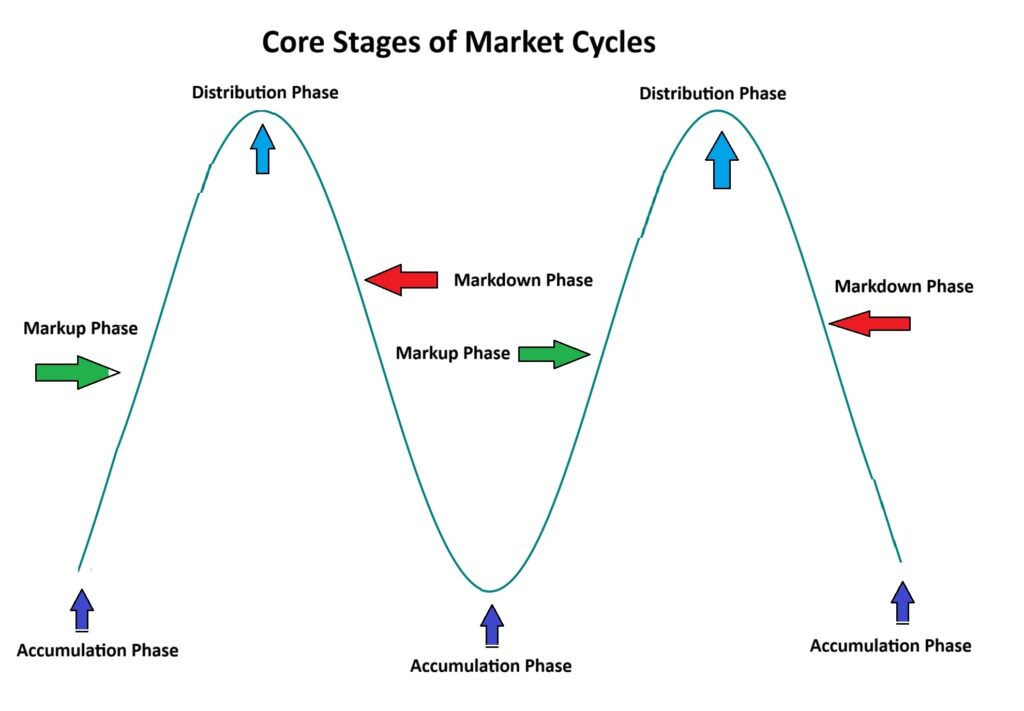
Phase 1: The Accumulation Phase
The term ‘accumulation’ usually applies to a phase after a major market crash, when prices are rising but turning flat. This phase could be referred to as “perhaps the worst is over.”
Even confidence remains low. Those who were only hurt by the previous loss may have no desire to come back, and others might want to get rid of any holdings they had.
Meanwhile, certain market participants might see the declining prices as an opportunity and start to pile up their assets. The price range can be fairly narrow and trading activity may not be quite as brisk as during periods of market excitement.
This gives a distinctive sense of sentiment. There are two camps: one who is not optimistic and another who thinks market conditions are improving.
Do not assume that prices are necessarily at their lowest levels. Even though the market is sideways, it can still go further down. The phase is primarily used to indicate a time when sales pressure seems to be subsiding, and confidence can slowly start to return.
Phase 2: The Markup Phase
If demand strengthens after accumulation, the market can move into the markup phase, sometimes described as the broader uptrend or bull-market stage. Prices begin trending upward more consistently, and sentiment becomes increasingly positive.
Many investors initially may be skeptical. It’s easy for a new rally to appear like it’s short-lived if it follows a significant pullback.
However, with the prices still moving forward, there is a possibility of changing the attitude from disbelief to wishing for something to optimism.
Higher prices can also bring new players in the game. The media starts to cover more and more, trading grows and previously risk averse investors might want to take a chance.
That’s where the fear of missing out (FOMO) can be game-changers.
Rather than inquire if the asset is reasonably priced, investors might start to purchase just because the asset is getting more expensive.
When optimism reaches an extreme level, the market can go into an euphoric mode. When prices reach new highs, a lot of attention can be paid to them and some participants start to think that prices can only go up.
This confidence can lead to conditions for the next stage.
Phase 3: The Distribution Phase
A phase of a well-established uptrend losing momentum is known as the distribution phase.
Sentiments can split up.
A few investors still believe the bull market is to be continued and they remain willing to purchase at high prices. Others think that much of the rally has already taken place and start cutting their positions or profit taking.
Consequently, prices can trade sideways or be very volatile.
A good rally can occur on one day and a bad day the following day. While current levels of highs can be difficult to sustain, the market sentiment on the whole may remain positive.
This is especially hard to identify during the distribution.
After a “rally” a sideways market should not be interpreted as an imminent major market decline. It may be a short-term merger that’s a precursor to another move.
Sentiment may turn sour at some point though if selling pressure eventually overpowers demand, the market can find itself in the markdown phase.
Phase 4: The Markdown Phase
The markdown phase is when the selling pressure takes over, and prices form a wider range of declines.
People’s psychology in the market is entirely different.
The party is over for those investors who were very bullish on during the rally may think at first that the fall is temporary. As prices continue to fall, confidence can emerge as anxiety, fear and panic.
This is the time when a bear market is present.
Declining prices will also stimulate further sales. A failure of any of these things could lead to liquidations, investors may decrease their exposure, and negative news can set bearish sentiment.
During times of extreme downturn, the market can go into capitulation, as investors lose faith in a market recovery in the near term.
The selling pressure can weaken at some point and prices can level off. Once this occurs, the market could start to create conditions for accumulation.
The cycle can repeat again and again… but the time frame is uncertain as well as the eventual recovery.
The Psychology Behind Crypto Market Cycles
Emotions are not the only thing that propel market cycles.
The simplified emotional cycle could be described as:
Fear → Disbelief → Hope → Optimism → Excitement → Euphoria → Anxiety → Fear → Panic → Capitulation
When valuations are on the high side, as is the case in a bull market, investors can grow more confident that recent events have shown that when they invest, they reap rewards.
This can create a situation of wanting to take risks and fear of missing out.
During a long downtrend, the reverse is possible. Declining prices increase investor caution, negative expectations permeate and some investors sell because they are afraid of further losses.
Acknowledging these feelings doesn’t mean that it is the right time to buy or sell. It can, however, offer an explanation as to why market behaviour can sometimes be extreme.
What Drives Crypto Market Cycles?
The investor’s psychology is only a small part of the equation.
The rule of supply and demand is still a key one. When demand exceeds supply, the price can increase. When there is more pressure to sell, prices may drop.
Macroeconomic conditions may also be relevant. Rates of interest, inflationary expectations, economic growth, market liquidity and investors’ overall appetite for risk can have an impact on cryptocurrency markets.
Regulatory measures can affect the availability of digital assets and the trust level of market participants in specific industry segments.
Technology and adoption are also key. Capital can be drawn by new blockchain applications, infrastructure enhancements, institutional involvement and new crypto stories.
But an unexpected event such as a security violation, project failure, or even the wider financial crisis can throw an apparently circular economy off course.
Common Mistakes During Crypto Market Cycles
The biggest error is assuming that the current trend will continue.
In bull markets, when prices rise quickly, some investors might mistakenly believe that risk is gone. This can lead to FOMO, over-leveraging, or making uninformed investment decisions.
But, in a bear market, the reverse will occur. One can get so afraid a person gets that all things seem to seem to be falling apart.
A second error is to use historical cycles as blueprints.
The market is dynamic, so the future cycles of cryptocurrencies may be vastly different. The factors of regulation, institutional participation, technology, liquidity and the economy are not the same across each cycle.