
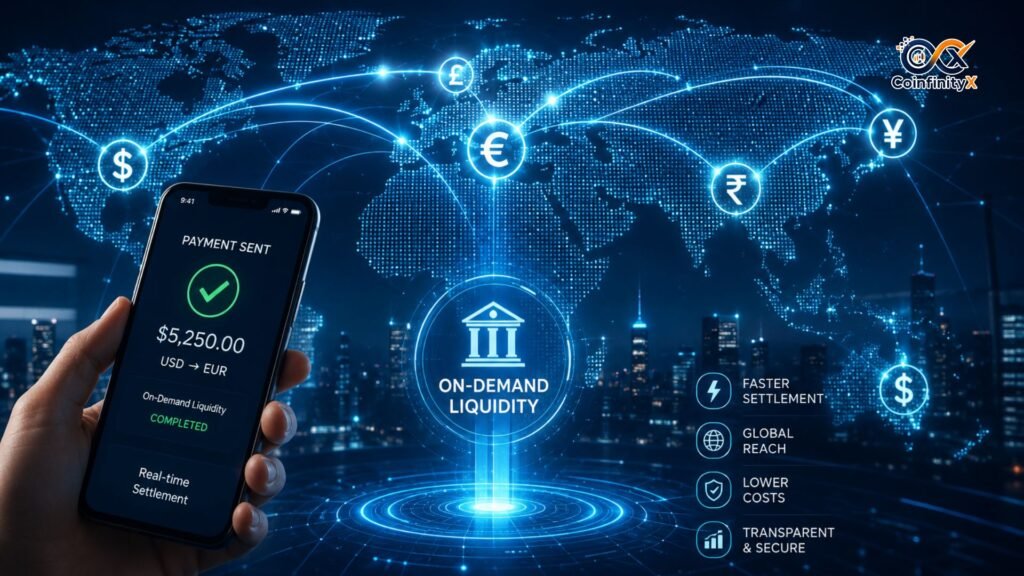
It is no hidden fact that this method of cross-border payments with high fees, longer time to process transactions, several intermediaries and currency conversions has been used for a while. On-demand liquidity (ODL) is one of the biggest innovations in this space.
The development will mean payment firms can access liquidity as and when they need, rather than hold large sums of capital in all their accounts around the world. On-demand liquidity and blockchain technology, digital assets, real-time payment networks, and automated financial infrastructure enable international payments to be faster, more flexible and cost efficient.
What Is On-Demand Liquidity?
Let us shift our focus to on-demand liquidity, which refers to the ability of obtaining funds for a payment transaction at the very point in time when it is required. Cross-border payments are commonly conducted using a legacy banking framework in which financial institutions hold nostro and vostro accounts (i.e., bank accounts denominated in foreign currencies held with other financial institutions).
For example, payment companies that do transactions between two countries may want to hold local currencies for each country at the destination country. Keeping these reserves requires a significant investment even if this capital is not currently been used for operations but probably does mean waiting times that go with it.
This is what an on-demand liquidity model tries to do. Instead of pre-funding these accounts, a payment provider may secure liquidity at the moment a transaction is initiated. This may facilitate the release of working capital and work to optimize international payment operations.
The Challenge with Traditional Cross-Border Payments
When it comes to international payments, moving money from one bank account to another is only the tip of the iceberg. Money can move from bank to bank, from payment processor to payment processor, from clearinghouse to clearinghouse, and then currency market to currency market dozens of times on the path a transaction tagged with that money takes before it reaches its destination.
An intermediary can drag costs or processing time each time. Please bear in mind that there may be additional charges for currency conversion, as exchange rates and spreads vary from one currency converter to another.
Another difficulty is pre-funded liquidity. Financial institutions and payment companies need to keep money in different currencies and another sector of different jurisdictions so that you will be employed. This does create an opportunity cost; capital locked in these accounts is less readily available.
These restrictions immediately become more of a concern for companies that wrangle with multiple markets. Liquidity management becomes more complicated the greater the number of countries and currencies in which a company operates.
Liquidity Management: How Technology Is Changing It
Financial technology advance made it possible for payment service providers to dynamically manage their liquidity. Modern payment platforms can connect banks, fintech companies, currency exchanges and digital payment networks to each other through automated systems.
Part of this transformation includes the implementation of blockchain technology. By having, for example, a blockchain that provides a common digital record of transactions it would allow value to move directly between participants and this at that point allows the ability to transfer value without having to traverse multiple correspondent banking [relationships].
The digital assets can also allow bridging between fiat currencies. Payment Providers → Instead of holding an entire pool full of that currency across various countries to move value between 2 currencies, a payment provider can use a digital asset or other liquidity mechanism.
Not only using digital assets, but more of being able to consume and carry liquidity when it needs to be moved rather than holding a huge amount of capital.
Faster Cross-Border Transactions

Among the major advantages of contemporary liquidity tools is swiftness.
For example, conventional international transfers involving many intermediaries and banking systems can take days, sometimes even weeks, to settle. Payment processing systems has far more complex ways payment will be settled within seconds.
We are seeing a growing number of real-time payment networks connected to cross-border payment networks. Such networks are one of the important components in automated liquidity management, so that payment providers can also offer their customers faster payments.
People benefit from faster processing of international remittances. Moreover, if the settlement happens faster then the business can manage its cash flow in a better way and does not have to deal with uncertainty with respect to international settlements.
Cost and Capital Efficiency Improvements
Say a business uses on-demand liquidity, it will also improve the utilization of capital.
Consider a financial institution which has to disburse in multiple currencies. Under a conventional setup, it would keep vast inventories of each currency. Some accounts may be over-funded and others not funded enough due to unexpected variances in payment volumes.
Well, a technology-based liquidity system can react to such changes more dynamically. Money is deployed according to the actual demand instead of holding at various locations.
Capital Efficiency: Both capital turnover and low capex lead to a low capital efficiency. By bolstering this efficiency, you can open up resources to enable operations, investment, or diversification in new markets.
Nonetheless, this cost benefit cannot be guaranteed. Liquidity, technology, currency conversions and compliance still add costs. Overall benefits are a function of payment corridor, market structure, transaction throughput and the actual payment technology.
The Role of Digital Assets
More and more often, these digital assets are proposed as elements of cross-border payment systems. They are capable of functioning on blockchain networks, allowing value to move without using traditional banking rails for each part of a transaction.
Example: A payment provider takes, say, a local currency from the customer; trades it into a digital asset; transmits the asset across blockchain network; and swaps/changes/exchanges it to local fiat of wherever the destination is. In a world where a digital asset is used to bridge two fiat currencies. This can be particularly useful in payment corridors where the traditional banking systems are expensive or inefficient.
On the other hand, digital assets also have their own challenges, including price fluctuations (halving), regulatory risk, liquidity problems, cyber security problems and stable capital to local currency conversions. As such, reliable payment systems must include both solid risk-management and compliance frameworks.
Benefits for Businesses and Consumers
Both firms and individuals can benefit from the transformation of cross-border payments.
International payments became faster and easier, so fewer steps are involved in businesses reporting how they pay suppliers, employees, contractors and partners abroad. International Transfer When a customer or a merchant is in need of transferring money, even if the transfer was not made on your E-Commerce business, you still earn money.
Antonius Kolonko, The consumers in the remittance market can be profoundly impacted. People from all around the world make electronic money transfers to family members in other countries. If payments are recurring regularly, even small enhancements in transaction cost and handling time can have a significant impact.
Contemporary liquidity models, for instance, provided by fintech platforms, also allow you to enter additional markets of financial services without making a whole, typical financial sector ecosystem in every country.
Challenges and Risks
On-demand liquidity for example can be immensely useful, but comes with problems too.
Regulation continues to be a major factor among them. Cross-Border Payments are subject to all the rules of anti-money laundering (AML), know your customer (KYC), sanctions, tax and consumer protection. Moreover, those requirements can differ dramatically from one jurisdiction to another.
Another issue is liquidity risk. Liquidity must be available in proximity to the exact moment of payment. If faced with market stress, payment providers might incur delays or higher costs in line with a less liquid market.
This also applies to technology and cyber security. Blockchain networks, payment streams, application programming interfaces (APIs), and digital wallets need protection from frauds, hacking, and operational failures in the sector.
Finally, interoperability remains essential. The gap between actual implementation of wholly-integrated payment systems on a real-world level versus communications and general standards of fiat-to-fiat payment networks is wide as can be to say the least.
The Future of Cross-Border Payments
Cross-border payments likely buns with a hybrid of traditional financial institutions in conjunction with new technologies. The payment ecosystem will continue to evolve and banks are likely to play important roles, but fintech firms, real-time payment networks, blockchain infrastructure and digital assets will become increasingly common in that mix over time.
At the center of this evolution is on-demand liquidity, which addresses one of the most basic banking needs – accessing cash where you need it when you need it without unnecessarily tying up capital.
Final Thoughts
On-demand liquidity is a big change from traditional cross-border payments. In some countries this large pre-funding capital is slowly being replaced with the access to dynamic liquidity in real time via modern technology, as transactions occur.
This change is powered by blockchain networks, digital assets, real-time payment processing systems, APIs and automated finance systems. This combination of technologies can dramatically reduce the time, cost, and efficiency for making international payments.